
Planning a trip to Italy? You’re going to need to bring along some Italy currency!
I’ve visited Italy several times. I’ve found that most businesses in large cities – like Rome, Florence, and Naples – will take credit cards.
But many times, smaller shops may only accept cash. (This is especially true if you’re visiting smaller towns in Italy).
It’s definitely a good idea to carry some money in Italy for making small purchases, and to pay at shops that don’t take payment by credit card. For example, when you’re buying a tasty gelato a local family-owned gelateria or tipping your tour guide.
Don’t worry, here’s everything you need to know about Italy’s currency to make sure you have a stress-free trip!
Disclaimer: This page may contain affiliate links. I earn a small commission if you make a purchase through these links (at no additional cost to you). See our Privacy Policy and our Disclaimer for more information.
What is the currency of Italy?
The official currency of Italy is the euro. The symbol of the euro is €.
The euro is used throughout the country of Italy, including all of the islands of Italy such as Sicily and Sardinia.
Italy was one of the first countries in Europe to start using the euro. The first euro bills and coins began use as legal tender in Italy on January 1, 2002.
In all, twelve countries started using the euro as official tender on this date: Germany, The Netherlands, Ireland, France, Austria, Belgium, Finland, Greece, Italy, Luxembourg, Portugal, and Spain.
What is the currency of Vatican City?
The official currency of Vatican City is the euro (€).
Although the Vatican is completely surrounded by Rome in Italy, it is actually an independent city-state. And it’s also the smallest country in the world, with an area of just over 100 acres.
Vatican City is not part of the EU or the eurozone. However, a contract was signed between Italy and the Vatican which allows the euro to be used as the official currency of Vatican City.
This is great, since it means you can use the same currency in Rome as when you walk across St. Peter’s Square to the Vatican!
What is the currency of San Marino?
The official currency of San Marino is the euro (€).
Like the Vatican City, the Republic of San Marino is another tiny country which is completely surrounded by Italy.
San Marino is not part of the European Union. But San Marino entered into a Monetary Agreement with the European Union and it has adopted the euro as its official currency (since 2002).
What is the euro?
The euro is a unit of money and the shared currency of many of the nations of the European Union (EU). The group of countries that use the euro are called the ‘eurozone’ or the ‘euro area’.
The euro (EUR) is the second most traded currency worldwide, with the United States Dollar (USD) as the most heavily traded currency.
There are a lot of financial and trade aspects that are simplified with the use of the euro as the common currency.
But what you care about, as a traveler, is that the euro makes your life much easier!
Before the euro came along, if you were planning a trip to more than one country in Europe, you’d need to exchange your money into the local currency every time you moved to a different country. (And exchange rates are not generally in the favor of the traveler.)
Let’s use an example of a trip itinerary starting in Barcelona, continuing on to Lyon, and then ending in Rome.
Before the euro, you would have needed three different types of money for this trip: Spanish pesetas, French francs, and Italian lira.
Today, you just need to get some euros, and you can use them in all three countries. Currency in France or Spain is the same as currency in Italy. This makes travel much simpler!
Euros are used within Ireland, but not in the Nothern Ireland. (Northern Ireland is part of the UK.) Be sure to bring your euros to Dublin, since Dublin is not in Northern Ireland!
What do euros look like?
Each euro bill features a different design of architectural elements. On one side you’ll find bridges along with a map of Europe. The other side depicts windows, arches, and columns. These are not actual bridges or columns, just generic representations.
I appreciate the design of the euro for both practical and aesthetic reasons (yep, they’re pretty).
The euro bank notes come in different sizes and colors for each denomination, with the smallest value bill also being the smallest-sized bill. With the size and color differences, it is easy to quickly tell the difference between €50 and €5 bills in your wallet.
With the size and color differences, the euro is a more friendly currency for people with vision impairments. (Unlike the United States bill denominations, which are all the same size and almost the same color.)
The euro bills also have fancy built-in security features such as holograms and watermarks.
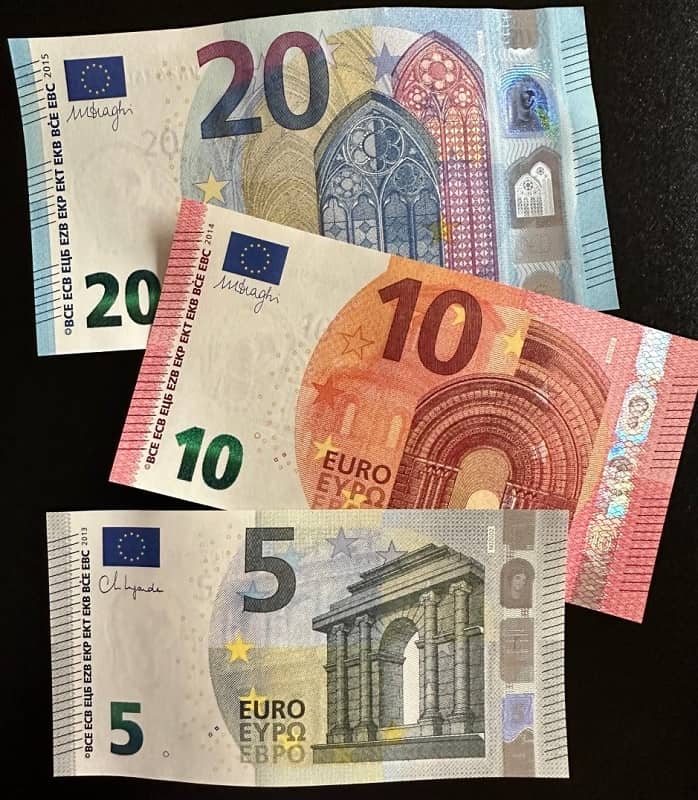
Photo courtesy of my good friend and fellow avid traveler, Leticia Hong
What are the denominations of euro bills?
The current series of euro bills come in six denominations: €5, €10, €20, €50, €100, and €200. (The previous series included €500 bills, but that denomination is no longer being issued as of April 2019)
For travel, it’s a good idea to carry various denominations of euros. Smaller shops might not be able to accept larger bills, so it’s better to carry €50 and below for daily use.
- 500 EUR: Physical size: 160mm x 82mm (physically the largest euro bill). This banknote is purple and depicts modern architecture. (Note: This denomination is no longer being issued.)
- 200 EUR: Physical size: 153mm x 82mm. The €200 banknote is yellow and depicts Art Nouveau architecture.
- 100 EUR: Physical size: 147mm x 82mm. The €100 bill is green and portrays Rococo and Baroque architecture.
- 50 EUR: Physical size: 140mm x 70mm. The €50 bill is orange in color and features Renaissance architecture.
- 20 EUR: Physical size: 133mm x 72mm. The €20 bill is blue and depicts Gothic architecture (my favorite architectural style).
- 10 EUR: Physical size: 127mm x 67mm. The €10 bill is red with elements of Romanesque architecture.
- 5 EUR: Physical size: 120mm x 62mm (physically the smallest euro bill). The €5 banknote is gray and features Classical architecture.
What are the denominations of euro coins?
Euro coins come in 8 denominations: 1 cent, 2 cent, 5 cent, 10 cent, 20 cent, 50 cent, €1 and €2.
The smallest euro coin denominations are ‘cents’, and 1 cent = 1/100 of €1.
Euro coins come in different sizes and metals, and they have different patterns on the edges of the coins. These differences also assist the visually impaired to more easily identify the proper coins.
All of the countries in the eurozone use the same designs on the euro bills, but each country can design the back of its euro coins. (It’s fun to see the different coin designs even if you’re not a coin collector.)
It’s easy to rack up a good amount of money in your pocketful of change, given that the euro equivalent of a $1 bill is a €1 coin.
You’ll certainly want to have some coins with you to throw into Trevi Fountain when you visit the famous Rome piazza, the Piazza de Trevi! (This is said to ensure your return to Rome!)
The €1 and €2 coins
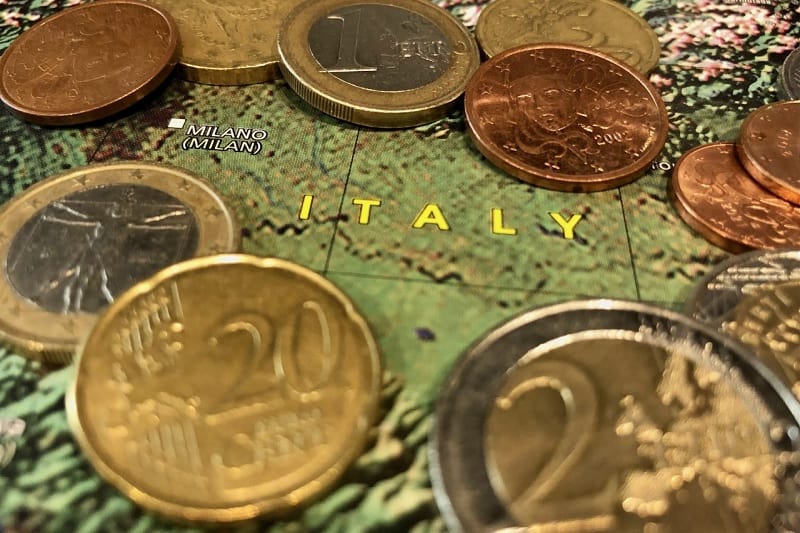
When you’re digging through your pocket for Italian money, the €1 and €2 coins are large and are easiest to identify since they’re made of two different metals.
- €2: The €2 coin is the largest of the euro coins. The inside of the coin is golden in color, with the outer ring being silver. The edge of the coin is patterned with fine ridges. Take a closer look at the edge and, you’ll notice small patterns and letters along the edge as well.
- €1: The €1 coin is another two-tone coin, with the metals inverted as compared to the €2 coin. On the €1 coin, the inside is the silver-colored metal, and the outer ring is the golden-toned metal. The edge of the €1 coin alternates smooth sections with sections of very fine ridges.
The Nordic Gold coins
- 50c: The 50c euro coin is physically the largest of the sub-€1 coins. The 50c coin is gold in color, made of a special alloy known as ‘Nordic gold’. The edge of the 50c coin is patterned with heavy ridges.
- 20c: The 20c coin is another euro coin made of the ‘Nordic gold’ alloy. It is smaller than the 50c coin and its edge is smooth but marked with 7 evenly spaced notches.
- 10c: The 10c euro coin is the smallest of the gold-toned ‘Nordic gold’ euro coins. The edge of the 10c coin is marked with heavy ridges.
The smallest euro coins
- 5c: The 5c euro coin is the first in the series of the tiniest denominations of euro coins, which are copper in color. The 5c coin has a smooth edge (and it looks a lot like a US penny).
- 2c: The 2c euro coin is copper in color and is smaller than the 5c coin. The edge of this coin is smooth but contains a groove.
- 1c: The smallest denomination of the euro, the 1c coin, is also physically the smallest coin. The 1c coin is copper in color with a smooth edge.

Euro coins: Pro tips
Pro Tip #1: Here’s one important reason to carry some cash that may surprise you: You’ll need to pay to use the restroom in public places like train stations, or even at fast food restaurants (if you’re not a ‘paying customer’).
Commonly the fee will be around 50 cents, but I’ve seen it be as high as €1. We always ensure we have a variety of change when we’re exploring a city, as you just never know when you’ll need it!
Prio Tip #2: It’s no fun fumbling through a mix of US coins and euro coins when you’re trying to pick out the right money to pay for your gelato – especially if there is a line of hungry people waiting behind you.
I like to bring along a Ziploc-style plastic bag and dump my US coins into that at the beginning of my vacation. That way I can speed things up at the register (without just handing over another bill and collecting yet more change in my pocket).
When you’re ready to go home, just swap out your change. Be sure to hold onto that bag of euro coins… given the €1 and €2 coins, a modest pile of change can add up quickly. And then you’ll have some coins on hand to bring with you for your next visit.
Which countries use the euro?
The euro is the common currency of the European Union – or rather, most of the European Union. Some of the countries have not yet met the criteria for economic stability criteria to allow them to use the euro.
The countries that do use the euro are a part of the ‘eurozone’ or ‘euro area’.
These are the current countries in Europe that are part of the eurozone, and hence use the euro as legal tender (listed in alphabetical order).
- Austria
- Belgium
- Croatia
- Cyprus
- Estonia
- Finland
- France
- Germany
- Greece
- Ireland
- Italy
- Latvia
- Lithuania
- Luxembourg
- Malta
- the Netherlands
- Portugal
- Slovakia
- Slovenia
- Spain
These countries that are part of the European Union, but have not met the economic stability conditions required to join the eurozone. (So, you’ll need to exchange your euros for local currency when traveling to these countries.)
- Bulgaria
- Czechia
- Hungary
- Poland
- Romania
- Sweden
And, we have one country that is part of the European Union, but that has opted out of using the euro as its legal tender. (Interestingly, European Union member countries can opt-out of various EU policies.)
- Denmark
I know, this whole EU vs eurozone vs Schengen area can get confusing pretty quickly. This map depicts which countries are in the European Union, which are in the eurozone, and which are part of the Schengen area.

Currency exchange rates
It’s important to at least have a rough idea of the currency exchange rates for your currency against the currency of your destination country.
The vast majority of the time the exchange is not going to be close to a 1 for 1. So, you’ll need to do a little bit of mental math to figure out what the prices are in terms of your home currency so that you don’t blow your budget.
The US dollar to euro exchange rates fluctuate significantly over time. On our first visit to Europe after the introduction of the euro, the exchange rate was about €1 = $1.3.
So, if your hotel costs €100 per night, you might think it’s a good rate until you realize it is really $130 per night, not $100 per night.
The exchange rates have been improving for the US in the last few years. On our trip to Europe last November, the exchange rate quite good – around €1 = $1.04. (In this case, the values were so close that I didn’t have to bother doing the math when making purchases!)
Before you travel to another country, do a quick check on the current exchange rates for your home currency vs the currency of the countries you’re visiting. This currency converter will provide the current exchange rate between any two currencies.
What was the previous currency of Italy?
Before the introduction of the euro, the previous currency of Italy was the Italian lira.
The Italian lira (ITL) was first introduced in 1807 and at the time was equivalent to the French franc. The lira was adopted by the states that became the kingdom of Italy in the year 1861.
Smaller denominations of money in Italy were called centesimi, where 100 centesimi = 1 lira.
The lira was the currency of Italy from 1861 until 2002, when the euro became the legal tender in Italy.
After the adoption of the euro as the official Italian currency in January 2002, there was a short period during which both the euro and the lira were accepted as legal tender. The lira was no longer accepted as legal tender in Italy after the 28th of February 2002.
The fixed exchange rate of the euro to the Italian lira (ITL): 1 EUR=1936.27 ITL.
If you still have Italian lira (or lire, plural) from a previous trip to Italy, unfortunately those are now just souvenirs. The Banca d’Italia (National Central Bank of Italy) stopped exchanging Italian lira for euros in 2012.
Italy Currency FAQ
Yes, France uses euros. The euro has been the official currency in Italy since January 1, 2002.
No, Italy does not still use lira. The lira was the Italian currency before euro, and now the euro is the legal Italian currency.
No, U.S. Dollars are not accepted as payment in Italy. You will need to pay in euros.
Italy currency is the euro (and the euro is the only currency that is accepted in Italy).
No, U.S. Dollars are not accepted in Rome. The currency used in Rome is the euro.
Yes, people use cash in Rome. Although credit cards are widely accepted in Rome, there are many small businesses that may only accept cash. Be sure to have bring some currency in Rome!
Before the euro, the currency in Italy was the lira. The euro became Italy’s currency in January 2002.
Yes, it is a good idea to take euros to Italy. Although you will be able to make many purchases with your credit card, you should always have some cash on hand for small purchases.
Sorry! The lira is no longer accepted as payment in Rome. The euro is now the money used in Rome.
Rome currency is the euro. Rome is the capital city of Italy, and since the official currency of Italy is the euro, that means the official currency of Rome is the euro.
The currency used in Italy is the euro. The euro has been the currency Italy uses since January 2002.
The Italy currency symbol is €. € represents the euro, the Italy currency name.
Now you know all the essential information about Italian currency, and can certainly answer the question ‘What currency does Italy use?‘
So go get some euros and have a fantastic trip! Buon viaggio!
Planning a trip to Italy? Pin this post for later!

You might also enjoy these posts about my favorite things to do in Italy:
- Beautiful Rome Piazzas
- Best Food Tours in Rome Italy
- Best Golf Cart Tours in Rome Italy
- Top Rome Instagram Spots
- Where is Rome? Rome Latitude and Longitude
- One Day Naples Italy Itinerary
Lisa Garrett
Lisa Garrett is a professional travel advisor and the founder of Waves and Cobblestones and Travel to Lyon. She has sailed 50 cruises across 11 cruise lines and has extensive firsthand experience traveling throughout Europe, including France, Italy, Portugal, Belgium, and more.
A passionate traveler and former engineer, Lisa brings her experience in research, planning, and problem-solving to helping clients plan memorable European vacations and cruises.
Learn more about Lisa!
