
Rome is a city where some of the best sightseeing happens when you’re simply walking from one place to another. On our most recent trip, we spent a lot of time crisscrossing the city, stopping in beautiful piazzas along the way.
From the grand fountains of Piazza Navona to the quieter Piazza della Minerva, Rome’s squares range from spectacular to wonderfully tucked away. And many of them put you right in the middle of the city’s history, art and architecture.
I’ve rounded up the Rome piazzas I think are most worth seeking out—including a couple of smaller favorites that are easy to overlook.
Disclaimer: This page may contain affiliate links. I earn a small commission if you make a purchase through these links (at no additional cost to you). See our Privacy Policy and our Disclaimer for more information.
Quick Picks: Top Rome Tours
- Rome in a Day with Vatican and Colosseum (Perfect if you’re short on time!)
- Rome by Golf Cart Private Tour (Top-rated private sightseeing tour)
- Rome Sunset Food & Wine Tour (Best-selling Rome food tour!)
- Expert-Led Rome Welcome Tour (The best way to start your Rome vacation!)
- Rome Vespa Tour by Night (An unforgettable way to see the Eternal City)
How I’d Explore Rome’s Piazzas
One of my favorite things about Rome is that you don’t have to make a special trip to see every piazza. Many of the city’s most beautiful squares are naturally part of the walking routes between Rome’s major sights.
If it’s your first visit, I’d group several piazzas together rather than trying to check them off one at a time. For example, you can visit Piazza Navona and the Pantheon together, then continue toward the Trevi Fountain. Another great walk takes you from Piazza del Popolo to the Spanish Steps and Piazza di Spagna.
I also recommend seeing some of the piazzas at different times of day. The Pantheon and Piazza della Rotonda are impressive in daylight, but the atmosphere changes completely after dark when the buildings and fountains are beautifully illuminated.
And don’t feel like you have to rush through them. Some of my favorite moments in Rome have been simply wandering into a piazza, stopping for a look around, and taking in the architecture and people-watching. Leave yourself a little time to do exactly that.
Planning a Trip to Rome?
Rome is one of those cities where a little planning can make a big difference—especially when you’re trying to balance the major sights with time to simply enjoy the city. I can help you put together a Rome itinerary that fits the way you actually like to travel, whether it’s your first visit or you’re returning to see more.
Planning your Rome trip? Let’s talk.
1. Piazza Navona

Piazza Navona is one of the Rome piazzas I think you should see on your first visit. Located in the heart of the city, this long, elegant square is surrounded by Baroque architecture, fountains, restaurants, and cafés.
What makes Piazza Navona especially interesting is what lies beneath it. The piazza was built on the site of the ancient Stadium of Domitian, which dates to 86 AD. The original stadium was eventually transformed into the piazza we see today, giving this beautiful square a fascinating connection to ancient Rome.
Take some time to walk the length of the piazza and admire its three fountains, the architecture, and the lively atmosphere. And don’t be surprised if you find yourself lingering here longer than expected—it’s a wonderful place for people-watching.
See Rome’s highlights, including the gorgeous Piazza Navona, on this private golf cart tour of Rome! Customize your tour from an extensive list of Rome’s top attractions to craft your perfect day in the Eternal City!
Piazza Navona Fountains
The fountains are the stars of Piazza Navona. The centerpiece is Bernini’s Fountain of the Four Rivers (Fontana dei Quattro Fiumi), one of the most recognizable Baroque fountains in Rome.
The four figures represent major rivers from four different continents: the Nile, the Ganges, the Danube, and the Rio de la Plata. An ancient Egyptian obelisk rises from the center of the fountain, adding even more drama to the composition.
At the northern end of the piazza, you’ll find the Fountain of Neptune (Fontana del Nettuno). Its central figure shows Neptune battling an octopus, surrounded by additional figures and sea creatures.
At the southern end is the Fountain of the Moor (Fontana del Moro), whose central figure of a Moor battling a dolphin was designed by Gian Lorenzo Bernini.
Even if you’re not particularly interested in Baroque art, take a few minutes to walk around the fountains. Each one has something different to discover.

Sant’Agnese in Agone
The beautiful Sant’Agnese in Agone stands prominently along the piazza and is well worth stepping inside.
This 17th-century Baroque church has an ornate façade, grand dome, sculptures, and frescoes. One of my favorite things to do here is simply look up at the frescoes decorating the cupola, particularly when sunlight is streaming through the windows.
The church also has a fascinating connection to the history of the site: according to tradition, Saint Agnes was martyred in the ancient Stadium of Domitian.
More to See Around Piazza Navona
If you have extra time, there are a few other sights worth knowing about near Piazza Navona.
The Museo di Roma, housed in Palazzo Braschi at the southwestern end of the piazza, explores the history and culture of Rome. Even if you don’t have time for the entire museum, there’s a great reason to stop by: the third floor offers wonderful views over Piazza Navona.
You’ll also find the underground Stadio di Domiziano archaeological museum, where you can see remains of the ancient stadium on which Piazza Navona was built. Models and multimedia displays help explain what the stadium looked like in ancient Rome. It’s also a nice option on a hot summer day when you need a break from the heat.
Just a short walk from the piazza is Santa Maria della Pace, a beautiful historic church known for its architecture, cloisters, and frescoes by Raphael.
Planning tip: Piazza Navona is easy to combine with other major sights in central Rome, including the Pantheon. Rather than making a separate trip just to see the piazza, I’d include it as part of a walking route through this part of the city.
2. Piazza del Popolo
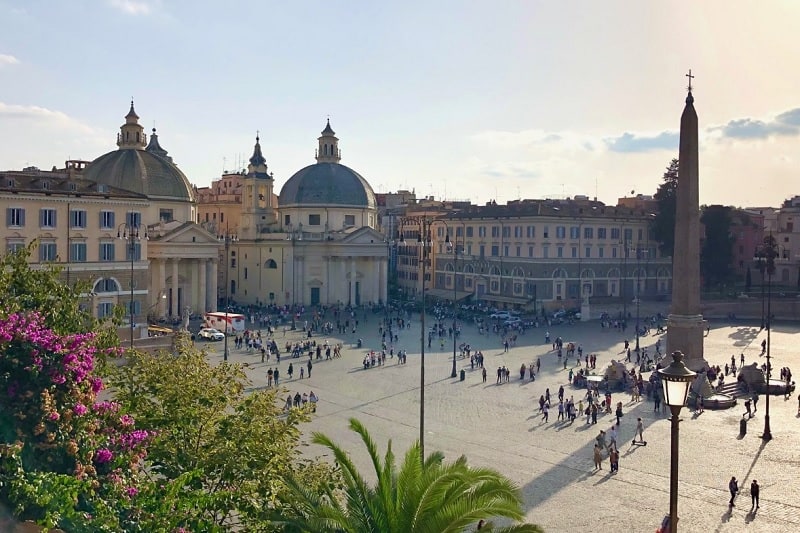
Piazza del Popolo is one of my favorite Rome piazzas for taking in the city’s architecture without quite as much of the hustle and bustle you’ll find around some of the more famous sights. Located at the northern end of Rome’s historic center, the expansive square is surrounded by fountains, churches, monuments, and some beautiful views.
It’s also a convenient stop if you’re exploring Rome on foot. Piazza del Popolo is roughly a 20-minute walk from Piazza Navona, the Pantheon, or the Trevi Fountain. If you’d rather save your steps, Flaminio metro station is just a few minutes away.
One of the things I particularly like about Piazza del Popolo is that it’s a little less crowded than Piazza Navona. That gives you more room to stop and appreciate the details—and there’s plenty to see. Piazzas like this are one of the things that makes Rome one of the most beautiful cities in Italy.
The piazza is also a great starting point for exploring Villa Borghese. From the northern end of the square, you can walk uphill into the gardens and enjoy some lovely views back toward Piazza del Popolo.
Piazza del Popolo Fountains

Three fountains and the monumental Flaminio Obelisk are among the highlights of the square.
In the center is the Fontana dei Quattro Leoni, or Fountain of the Four Lions, designed by Giuseppe Valadier in 1828. Four marble lions surround the base of the ancient Flaminio Obelisk, which dates to the reign of the Egyptian pharaoh Ramses II.
At the southwestern end of the piazza is the Fontana del Nettuno, featuring Neptune with his trident accompanied by two Tritons. Across the square, the Fontana della Dea di Roma, or Fountain of the Goddess of Rome, sits at the northeastern end.
Take a moment to walk around the entire piazza rather than viewing it from just one spot. The fountains, obelisk, churches, and surrounding buildings create a very different view from each side.
The Twin Churches of Piazza del Popolo
At the southern end of Piazza del Popolo, two Baroque churches stand almost like mirror images on either side of Via del Corso: Santa Maria dei Miracoli and Santa Maria in Montesanto.
Santa Maria dei Miracoli has an ornate façade and elegant bell towers, while Santa Maria in Montesanto is known for its distinctive dodecagonal dome. The latter is also nicknamed th
You don’t necessarily need to visit both churches, but they’re worth a look as you explore the piazza. And when you stand in the center of the square, notice how the churches frame the entrance to Via del Corso, one of Rome’s best-known shopping streets.
My tip: If you’re already exploring central Rome, don’t think of Piazza del Popolo as a destination that requires a special trip. It’s an easy addition to a walking route, and the combination of the piazza and nearby Villa Borghese makes it particularly worthwhile.
3. Piazza de Trevi

The Trevi Fountain is one of Rome’s most iconic sights, and yes—it’s worth seeing in person. Tucked into the relatively small Piazza di Trevi, the fountain feels even more dramatic because of the way the enormous Baroque sculpture fills the space.
The 18th-century fountain was designed by Nicola Salvi, with the ornate Palazzo Poli providing its backdrop. At the center, Oceanus rides a shell-shaped chariot pulled by two hippocamps—mythical creatures with the upper body of a horse and the lower body of a fish.
The Trevi Fountain has also had plenty of screen time over the years, appearing in films including Roman Holiday, La Dolce Vita, and Three Coins in the Fountain. It’s easy to see why filmmakers have been drawn to it.
(And of course non-professionals too — it’s one of the most popular Instagram spots in Rome, and a great place for an unforgettable Rome photo shoot.)
Don’t Skip the Trevi Fountain at Night
The Trevi Fountain is impressive during the day, but I recommend seeing it again after dark. The lighting gives the fountain a completely different atmosphere, and this is one of those Rome sights that’s worth experiencing at two different times of day.
And, of course, you’ll probably want to participate in the famous coin-tossing tradition. According to legend, throwing a coin into the fountain ensures that you’ll return to Rome.
One practical note: don’t try to retrieve coins from the fountain. The money is collected and donated to charity, and taking it is considered theft.
You’ll find plenty of cafés, bars, and gelaterias in the streets around Piazza di Trevi, so this is a good place to pause for a gelato before continuing your Rome sightseeing.
Watch for Scams Around the Trevi Fountain
The Trevi Fountain’s popularity also makes it a place where you need to keep your wits about you.
On one of our first visits to Rome, a man handed me a rose while we were admiring the fountain. I thought it was simply a nice gesture—until he turned to my spouse and demanded money.
That became one of our early travel-scam lessons: never let a stranger put something in your hand. What looks like a free gift may not be free at all.
The Trevi Fountain is also one of the most popular photo spots in Rome, so expect crowds, particularly during the busiest parts of the day. If you want a more relaxed experience, an early morning or later evening visit is worth considering.
Planning tip: Trevi Fountain is easy to combine with other central Rome sights, including the Pantheon and Piazza Navona. Rather than treating it as a quick photo stop, I’d give yourself time to walk around the piazza, admire the fountain from different angles, and soak up the atmosphere.
4. Piazza Venezia

Piazza Venezia sits at the heart of Rome’s historic center, where several of the city’s major sights and historic streets come together. It’s a busy piazza, but it’s worth taking some time to explore rather than simply passing through.
You’ll find several notable buildings and monuments around the square. Palazzo Venezia, on the northwest side, is a 15th-century palace that now houses a museum with collections of medieval and Renaissance art.
Across the piazza, Palazzo Bonaparte is an elegant 17th-century mansion where Napoleon’s mother, Letizia Bonaparte, lived for many years. Today, the palace hosts temporary exhibitions.
Nearby, Trajan’s Column rises above the ruins of the Imperial Fora, giving you a glimpse into the monumental public spaces of ancient Rome. The churches around the piazza, including Santa Maria di Loreto, add another layer of history and architecture to the area.

Altare della Patria
But the star of Piazza Venezia is undoubtedly the Altare della Patria, or Altar of the Fatherland. This enormous white marble monument was one of our first stops on our recent trip to Rome, and its scale is difficult to appreciate until you’re standing in front of it.
The monument includes the Tomb of the Unknown Soldier and the impressive equestrian statue of Victor Emmanuel II, Italy’s first king and an important figure in the country’s unification.
One of my favorite things about visiting the Altare della Patria is going up to the Terrazza delle Quadrighe. The panoramic views are fantastic, with the ruins of the Imperial Fora below and the Colosseum visible in the distance.
And don’t forget to look back toward Piazza Venezia itself. From above, you’ll get a completely different perspective of the busy square and its surrounding architecture.
Planning tip: Piazza Venezia is easy to combine with the Roman Forum and Colosseum, which are just a short walk away. You can also walk from here toward the Trevi Fountain or the Pantheon, making this an easy stop to incorporate into a day of exploring central Rome.
5. Piazza San Pietro
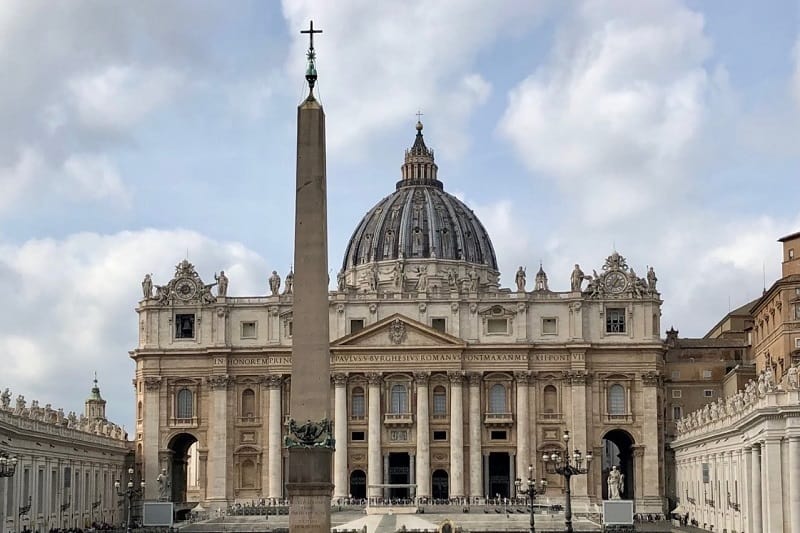
Piazza San Pietro, or St. Peter’s Square, is one of the most recognizable piazzas in Rome—and one of those places that feels even more impressive when you’re standing in the middle of it.
Technically, you’re not in Rome at this point. Piazza San Pietro sits within Vatican City, the world’s smallest independent country, which is completely surrounded by Rome.
The centerpiece of the square is St. Peter’s Basilica, one of the world’s most important churches and an extraordinary work of Renaissance and Baroque architecture. The basilica was built over the traditional burial site of St. Peter, one of Jesus’s apostles and the first pope.
Even if you’re not particularly interested in religion, I think St. Peter’s Basilica is worth seeing. The architecture, art, and sheer scale are remarkable, and it’s one of the most beautiful churches in Italy.
Bernini’s Colonnades
One of the most distinctive features of Piazza San Pietro is the enormous pair of curved colonnades that frame the square. Designed by Gian Lorenzo Bernini, they consist of 284 columns arranged in four rows.
Look up as you walk around the piazza and you’ll also see 140 statues of saints and martyrs standing above the columns.
There’s an interesting optical effect here, too. Look for the markers on the pavement that indicate the center of the colonnades. From these points, the rows of columns appear to line up almost perfectly, making the columns behind them seem to disappear.
The Vatican Obelisk
At the center of Piazza San Pietro stands an ancient Egyptian obelisk made of red granite. It was brought to Rome during the Roman era and later moved to its current location in the 16th century.
The obelisk is also part of the original design of the piazza’s pavement and functions as a giant sundial. If you look down while you’re exploring the square, you’ll see markings that help indicate the position of the sun.
Piazza San Pietro can be especially busy during papal audiences, major religious celebrations, and other events involving the pope. But even when the square is crowded, there’s something remarkable about standing beneath Bernini’s colonnades and looking toward the basilica.
And here’s the best part for budget-conscious travelers: walking around Piazza San Pietro is completely free, making it one of the free things to do in Rome.
Visiting the Vatican
If you’re planning to visit the Vatican Museums and Sistine Chapel as well, allow considerably more time than you’ll need for the piazza itself. The museums contain an enormous collection of art and historical treasures, while the Sistine Chapel is famous for Michelangelo’s Renaissance frescoes, including The Creation of Adam.
Keep in mind that the Vatican Museums have a dress code: shoulders and knees must be covered, and hats aren’t permitted.
Planning tip: I would combine Piazza San Pietro with a visit to St. Peter’s Basilica and the Vatican Museums rather than treating the square as a separate stop. The piazza itself doesn’t require a lot of time, but you’ll want to allow several hours if you’re exploring the Vatican Museums and basilica as well.
Find the Vatican experience that is best for you:
6. Piazza della Rotonda

Piazza della Rotonda is one of those Rome piazzas where the setting is almost as memorable as the attraction itself. Located in the heart of the historic center, the square is dominated by the magnificent Pantheon, with its distinctive ancient columns and enormous dome.
The piazza itself is paved with traditional Roman cobblestones and has a lively atmosphere, with cafés, restaurants, and shops surrounding the square. It’s a wonderful place to stop for a look at the Pantheon—and perhaps a gelato. (I’m still taste-testing my way through Italy to find all the best gelato in Italy!)
In the center of the piazza is the Fontana del Pantheon, a 16th-century fountain topped by an Egyptian obelisk. Take a closer look at the decorations around the fountain. You’ll find elaborate fish, some rather aggressive-looking dolphins, and a little figure that looks suspiciously like a dog with wings. (I don’t remember anything like that from mythology class…)
The Pantheon
The Pantheon is one of the best-preserved buildings from ancient Rome and one of the city’s most remarkable sights. Its enormous portico, lined with classical columns, gives you a pretty good idea of what you might expect from an ancient Roman temple—but the interior is where the building really gets impressive.
The Pantheon was rebuilt under the emperor Hadrian around 126 AD, on the site of an earlier temple. It later became a Catholic church, officially known as the Basilica of St. Mary and the Martyrs.
The building’s most famous feature is its enormous dome, which was the largest unreinforced concrete dome in the world for centuries. At the very top is the oculus, an open circular hole that provides the building’s only direct source of natural light.
If you visit on a sunny day, you’ll see the beam of sunlight move across the interior as the sun changes position. It’s one of the reasons I recommend seeing the Pantheon during the day.
See Piazza della Rotonda at Night
If you have the time, I’d actually recommend visiting Piazza della Rotonda twice.
During the day, the light coming through the Pantheon’s oculus is one of the highlights. But after dark, the atmosphere changes completely. The Pantheon and surrounding buildings are beautifully illuminated, and the piazza takes on a much more relaxed, atmospheric feel.
Piazza della Rotonda is also easy to combine with several other sights in central Rome, particularly Piazza Navona and the Trevi Fountain. It’s one of those places where I’d encourage you to slow down rather than simply take a photo and move on.
7. Piazza di Spagna

Piazza di Spagna is one of the most recognizable squares in Rome, sitting at the foot of the famous Spanish Steps. It’s a lively part of the historic center and an easy stop to include while exploring Rome on foot.
The centerpiece of the piazza is the Fontana della Barcaccia, a charming Baroque fountain shaped like a ship. Created in the 17th century, the fountain sits at the base of the Spanish Steps and is one of the first things you’ll notice as you arrive.
The Spanish Steps
The Spanish Steps, known in Italian as the Scalinata di Trinità dei Monti, connect Piazza di Spagna with the church of Trinità dei Monti above. The 135 steps were completed in the 18th century and have become one of Rome’s most recognizable landmarks.
The steps were designed by architect Francesco de Sanctis and have long been a popular gathering place. Climb to the top and you’ll be rewarded with beautiful views over the rooftops of Rome. I particularly enjoy seeing the city from here in the evening, when the piazza and surrounding buildings are illuminated.
One important tip: don’t sit on the Spanish Steps. Sitting on the steps is prohibited, and you could receive a hefty fine. That’s definitely not how I’d recommend spending your Rome vacation budget!
Even if you only have 48 hours in Rome, I’d put Piazza di Spagna and the Spanish Steps on your list. They’re easy to combine with other central Rome sights, and the area is also a great place to wander, shop, and stop for a coffee or gelato.
8. Piazza del Colosseo

Piazza del Colosseo is one of those places in Rome where it’s hard not to stop and stare. The enormous Colosseum rises directly from the piazza, offering an immediate glimpse into the scale and engineering of ancient Rome.
The Colosseum was built between 70 and 80 AD under Emperor Vespasian and became the largest amphitheater in the Roman world. It hosted gladiatorial contests, animal hunts, public spectacles, executions, and other events that drew enormous crowds.
I am constantly amazed by the engineering prowess of the Romans. We can build incredible things with modern technology, but I’m pretty sure nothing built today will still be standing 2,000 years from now!
I’ve seen Roman arenas in several places, including Arles and Nîmes in France. Both are fascinating, but I have to admit that I was more impressed by the remarkably well-preserved arena in Nîmes. If you’re interested in Roman history, you can see more of my thoughts in my guide to the best things to do in Arles.
The Arch of Constantine
While you’re visiting the Colosseum, don’t overlook the Arch of Constantine, just a short walk from the amphitheater.
This impressive triumphal arch was built to celebrate Emperor Constantine’s victory and is decorated with reliefs depicting battle scenes, figures, and other elements from Roman history.
It’s an easy addition to your visit, and you don’t need much extra time to stop and appreciate the details.
Visiting the Colosseum
If you want more than a view from the piazza, there are several ways to experience the Colosseum. Standard admission lets you explore the main areas, while specialized tours can take you into areas such as the underground sections that aren’t included with every ticket.
I’ve also found that time of day makes a difference. Rome can be extremely hot in summer, so an early morning or evening visit can be much more comfortable. And if you’re planning a summer trip, these tips on what to wear in Italy in summer can help you prepare for sightseeing in the heat.
Planning tip: Don’t think of Piazza del Colosseo as just a place to see the Colosseum. It’s also a natural starting point for exploring the Roman Forum and Palatine Hill, so I’d plan these sights together rather than making separate trips.
9. Piazza del Campidoglio

Perched on top of Capitoline Hill, Piazza del Campidoglio is one of Rome’s most distinctive squares—and a great stop to add while you’re exploring the area around Piazza Venezia.
The piazza was designed by Michelangelo in the 16th century. Its unusual trapezoidal shape, grand stairway, statues, and carefully planned paving give it a very different feel from many of Rome’s other historic squares..
Entering Piazza del Campidoglio
The traditional approach is via the Cordonata Capitolina, the broad staircase-like ramp that leads up to the piazza. At the bottom, you’ll find the Fontane dei Leoni Egizi, while statues of Castor and Pollux stand guard near the top.
At the center of the square is an equestrian statue of Marcus Aurelius. Look down at the paving around it, too. The stones form a distinctive geometric pattern radiating outward in a 12-pointed star.
The pattern is much easier to appreciate from above, so if you have the opportunity to look down on the piazza from a higher vantage point, take it.
Capitoline Museums
Piazza del Campidoglio is also home to the Capitoline Museums, one of the most important museums in Rome. The collections include ancient Roman and Greek sculpture, archaeological artifacts, and Renaissance and later artworks.
If you’re interested in ancient Rome, I’d allow extra time here. The museums are a particularly good complement to the nearby Roman Forum and Colosseum because you’ll see many of the sculptures and artifacts that help bring Roman history to life.
Planning tip: Piazza del Campidoglio is just south of Piazza Venezia, so I’d visit the two together rather than making a separate trip. From here, you can also continue toward the Roman Forum and Colosseum.
10. Piazza di Santa Maria Maggiore and Piazza dell’Esquilino

You get two piazzas for the price of one with this entry!
The Piazza di Santa Maria Maggiore and Piazza dell’Esquilino sit on opposite sides of the magnificent Basilica Papale di Santa Maria Maggiore, one of Rome’s four papal basilicas. They’re a little farther from Rome’s biggest tourist attractions, which makes this a nice area to explore when you want to see something impressive without quite as much of the usual crowds.
Two Views of Santa Maria Maggiore
The Piazza di Santa Maria Maggiore sits on the eastern side of the basilica. From here, you can admire the grand columns of the façade and the basilica’s medieval bell tower, which is the tallest in Rome.
The piazza also features the Colonna della Pace, or Column of Peace, a tall ancient column topped with a bronze statue of the Virgin Mary and Child.
Walk around to the western side of the basilica and you’ll reach Piazza dell’Esquilino. The large cobblestoned square is dominated by an ancient Egyptian obelisk, and from here you get a completely different view of the basilica, including its distinctive twin domes.
My tip: Don’t just admire Santa Maria Maggiore from one side. Take a few extra minutes to walk around the basilica and see it from both piazzas. The views are surprisingly different, and it’s an easy way to get more out of your visit.
Basilica Papale di Santa Maria Maggiore
The basilica dates back to the 5th century and is known for its magnificent mosaics, marble columns, and ornate gilded ceiling. It’s also the final resting place of Gian Lorenzo Bernini, the Baroque sculptor and architect whose work appears throughout Rome.
If you’re interested in Rome’s churches and architecture, Santa Maria Maggiore is well worth adding to your sightseeing list. You can find more impressive churches to visit in my guide to the best European cathedrals and basilicas.
Planning tip: Santa Maria Maggiore is easy to visit when you’re exploring the Esquilino neighborhood or arriving at nearby Roma Termini. I’d consider it a particularly good choice if you’ve already seen the major sights in central Rome and want to explore a slightly different part of the city.
Bonus #1: Piazza della Minerva

There are plenty of grand and famous piazzas in Rome, but some of my favorites are the little squares you might otherwise walk right past.
One of those is Piazza della Minerva, a small square tucked just behind the Pantheon. Because it’s so close to the much busier Piazza della Rotonda, it’s easy to miss—but I think it’s worth taking a few minutes to find.
The piazza faces the Basilica di Santa Maria sopra Minerva, one of Rome’s historic churches. The exterior is relatively understated, so it doesn’t necessarily grab your attention the way some of Rome’s more elaborate churches do.
What will grab your attention is the elephant statue in the center of the square.
The sculpture, known as the Pulcino della Minerva, features a small elephant carrying an ancient Egyptian obelisk on its back. I love the expression and personality in the elephant, and the details are fun to examine up close.
My tip: If you’re visiting the Pantheon, don’t just head straight back to the main tourist route. Walk around the back of the building and spend a few minutes in Piazza della Minerva. It’s a tiny detour that rewards you with a completely different—and much quieter—side of central Rome.
Bonus #2: Piazza di Ponte Sant’Angelo

Although it’s officially called a piazza, Piazza di Ponte Sant’Angelo feels more like an approach to the bridge than a traditional Roman square. But don’t let that stop you from including it in your Rome sightseeing.
This is the gateway to Ponte Sant’Angelo, the spectacular bridge spanning the Tiber, with Castel Sant’Angelo rising dramatically at the other end.
Walk Across Ponte Sant’Angelo
Ponte Sant’Angelo dates back to the 2nd century AD, when it was built by Emperor Hadrian to connect the city with his mausoleum, now known as Castel Sant’Angelo.
As you cross the bridge, take your time to admire the ten angel statues lining the parapets. The statues were designed by Gian Lorenzo Bernini and his workshop, and each angel holds an object associated with the Passion of Christ.
You’ll also find statues of Saint Peter and Saint Paul at the entrance to the bridge. The combination of the sculptures, the river, and Castel Sant’Angelo makes this one of my favorite walks in this part of Rome.
Castel Sant’Angelo
The massive circular structure at the end of the bridge is Castel Sant’Angelo. It was originally built as a mausoleum for Emperor Hadrian and his family before being transformed over the centuries into a fortress and castle.
Today, Castel Sant’Angelo is a museum, and you can explore its interior and climb to the upper levels for panoramic views over Rome and the Vatican.
If you don’t have time for the museum, it’s still worth crossing the bridge simply to appreciate the building from the outside. The perspective from Ponte Sant’Angelo is particularly impressive.
The castle is surrounded by Parco della Mole Adriana, a small green space where you can take a break and escape the bustle of the surrounding streets.
Planning tip: Ponte Sant’Angelo is an easy addition to a Vatican sightseeing day. I’d walk across the bridge on your way toward or away from St. Peter’s Square rather than making a separate trip just to see the piazza.
Rome Piazzas Map
You’re probably wondering where all of these piazzas are located in Rome. Some of them are close to each other, and some are more of a hike to go and see.
Here’s a map of Rome piazzas that I talked about in this post:
Famous Rome Piazzas FAQ
A piazza is a public square, and the term is most commonly used in Italy. The term square is used loosely – it can be an actual square, or more rectangular. The piazza’s shape is determined by the buildings surrounding it.
There are over 2000 piazzas in Rome, ranging from small squares to grand, monument-filled plazas.
The most famous piazza in Rome is Piazza Navona. This breathtaking square features three stunning fountains, including the iconic Fountain of Four Rivers, and the baroque church Sant’Agnese in Agone.
The most beautiful squares in Rome are Piazza Navona and Piazza del Popolo. Piazza Navona is the more popular of the two piazzas, as it is closer to many of Rome’s top attractions.
But Piazza del Popolo is also gorgeous with its twin churches. And, since it’s a little further away, Piazza del Popolo is generally less crowded, so you can better enjoy the beauty of the piazza.
The largest square in Rome is Piazza San Pietro. St. Peter’s Square 320 meters long and 240 meters wide, and can hold an incredible 300,000 people.
The three best Rome piazzas to see at night are Piazza de Trevi (toss a coin in the fountain), Piazza della Rotonda (see the classical temple of the Pantheon illuminated), and Piazza di Spagna (climb the Spanish Steps to see the twinkling lights of Rome at night!).
Rome is gorgeous at night with its fountains and monuments illuminated — so be sure to walk off your dinner with a stroll around Rome’s beautiful plazas. Or take a Rome at night tour so that you don’t miss any highlights!
The Via del Corso links the Piazza del Popolo and Piazza Venezia in Rome. It’s about a 20-minute walk between these two Roman piazzas.
Final Thoughts:
The wonderful thing about Rome’s piazzas is that you don’t really have to go looking for them. They’re woven into the city, and some of my favorite Rome moments have happened while wandering from one major sight to another.
If you’re planning your first trip to Rome, I’d prioritize Piazza Navona, Piazza della Rotonda, Piazza di Trevi, Piazza del Popolo and Piazza San Pietro. But if you have a little more time, leave room for some of the smaller squares, too. You never know which one might become your favorite.
If you’re looking for an easier way to cover Rome’s major sights, my guide to the best Rome golf cart tours is a good place to start. And if food is one of your priorities, I’ve also rounded up my favorite Rome food tours.
Are you ready to book your trip to Rome?
Looking for the top picks for your trip to Rome? Here are some of the best tours, hotels, and more to help you plan the perfect vacation!
Top Tours and Experiences in Rome
- Rome in a Day with Vatican and Colosseum (Perfect if you’re short on time!)
- Rome by Golf Cart Private Tour (Top-rated private sightseeing tour)
- Rome Sunset Food & Wine Tour (Best-selling Rome food tour!)
- Expert-Led Rome Welcome Tour (The best way to start your Rome vacation!)
- Rome Vespa Tour by Night (An unforgettable way to see the Eternal City)
Top Hotels in Rome
- Starhotels Metropole (I stayed here! 4-star hotel with convenient location near Roma Termini)
- Parco dei Principi Grand Hotel & Spa (5-star splurge on the Borghese Gardens!)
- Palazzo Navona Hotel (4-star hotel with fabulous location on Piazza Navona!)
Planning a trip to Rome? Pin this for later so you don’t miss any of the most beautiful piazzas in Rome!


You might also enjoy these posts about my favorite Mediterranean cruise ports:
- 12 Best Rome Food Tours to Enjoy
- Best Rome Golf Cart Tours: 5-Star Sightseeing Fun
- One Perfect Day in Naples: Best Things to Do in Naples, Italy
- Where is Rome? Rome Latitude and Longitude (& Fun Facts)
- Nice vs Marseille: Which is the Best City to Visit?
- Amazing Things To Do in Nice and the French Riviera
- Perfect Weekend in Spain: Best Things to Do in Barcelona
- La Rambla: Enjoy the Most Famous Street in Barcelona
Lisa Garrett
Lisa Garrett is a professional travel advisor and the founder of Waves and Cobblestones and Travel to Lyon. She has sailed 50 cruises across 11 cruise lines and has extensive firsthand experience traveling throughout Europe, including France, Italy, Portugal, Belgium, and more.
A passionate traveler and former engineer, Lisa brings her experience in research, planning, and problem-solving to helping clients plan memorable European vacations and cruises.
Learn more about Lisa!
