
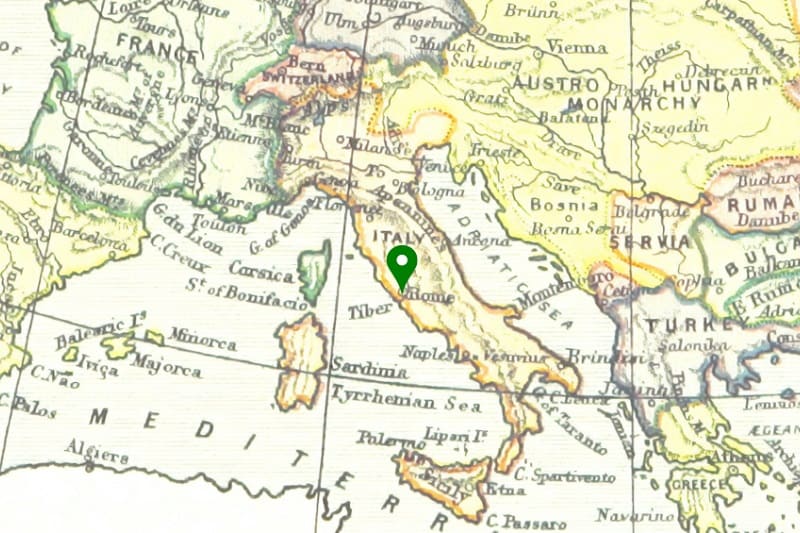
Rome, the Eternal City, sits proudly in the heart of Italy. But you might be wondering: what exactly is the Rome latitude and longitude?
With coordinates of 41°54′ N 12°29′ E (41.90 degrees North latitude and 12.49 degrees East longitude), Rome enjoys a Mediterranean climate.
This means that temperatures are usually mild year-round, making it a great choice for travelers who want to explore without worrying about extreme weather conditions.
Summertime in Rome can be hot and sunny, with temperatures occasionally reaching over 30°C (86°F). Winter is cooler, with temperatures rarely dropping below 0°C (32°F).
Rome has a reputation for being one of the sunniest cities in Europe – so don’t forget to pack your sunglasses!
Ready to learn all about Rome latitude and longitude and how this impacts the weather in Rome?
Lace up your shoes and let’s go!
Disclaimer: This page may contain affiliate links. I earn a small commission if you make a purchase through these links (at no additional cost to you). See our Privacy Policy and our Disclaimer for more information.
Where is Rome? Rome latitude and longitude
Where is Rome?
Rome is located in central Italy, in the region of Lazio. Sitting on the Tiber River, Rome is a bustling metropolis filled with culture, history, art, fashion and cuisine.
Rome was once the center of the Roman Empire, one of the most powerful empires in world history. Today Rome is the capital of Italy, a country located in Western Europe. The neighboring countries of Italy are France, Switzerland, Austria and Slovenia.
The Vatican City, the smallest country in the world, is located completely within the city of Rome.

What is the latitude of Rome?
The latitude of Rome is 41.9°N, which means it is located in the northern hemisphere. Rome is a little less than halfway between the Equator and the North Pole.
What is the longitude of Rome?
The longitude of Rome is 12.5°E. This means that it is located eastward from the Prime Meridian, a reference line designated as the 0 degrees longitude location on the globe.
What parallel is Rome Italy?
Rome Italy is located on the 41st parallel north, which is an imaginary line that circles the globe horizontally.
This particular parallel passes through Rome as well as several other major cities including Barcelona, Spain and Porto, Portugal. It also cuts through many different landscapes including forests, deserts and mountain ranges.
Does latitude impact hours of daylight?
Yes, latitude has an impact on hours of daylight. The higher the latitude, the longer the days are in summertime and the shorter the days are in winter.
Since Rome is in the Nothern hemisphere, summer months are June, July, and August. For cities in the Southern hemisphere, summer months are December, January, and February.
Does longitude impact hours of daylight?
No, longitude does not have an impact on hours of daylight. The amount of daylight a city experiences is dependent only on its latitude.
Longitude relates to how far east or west a location is from the Prime Meridian. Its longitude is only used to pinpoint its location coordinates.
How many hours of daylight are there in Rome in the summer?
In the summer months, Rome experiences an average of 13-14 hours of daylight per day. The precise amount of daylight varies depending on the time of year and orientation to the sun.
The longest day (most hours of daylight) occurs on the summer solstice, which typically falls on June 20th or 21st.
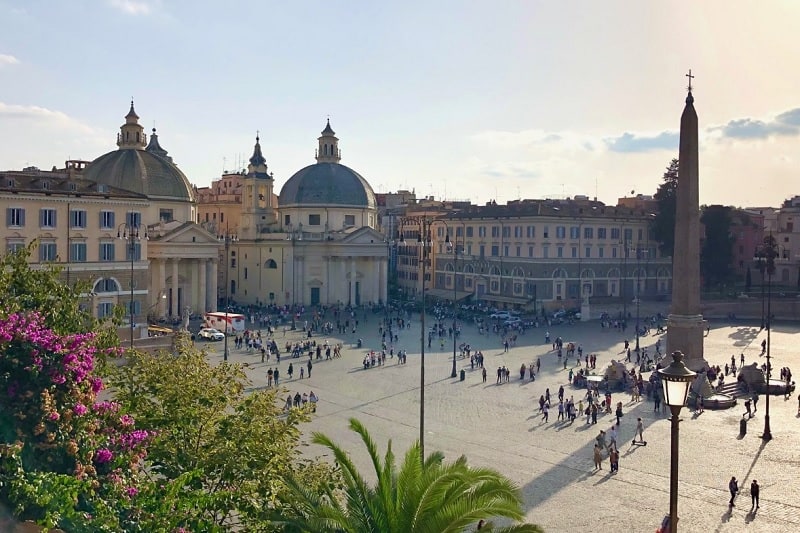
In the summer, you’ll have plenty of time to get photos at the best Instagram spots in Rome, and to spend a relaxing evening enjoying the beauty of one of Rome’s famous piazzas!
Summer days in Rome may be long, but they’re not as long as in more northerly cities. Due to London’s latitude, its summer days are extra-long!
How many hours of daylight are there in Rome in the winter?
In the winter months, Rome experiences an average of 8-9 hours of daylight per day. This is significantly less than what they experience in the summer months.
The shortest day (least hours of daylight) occurs on the winter solstice, which typically falls on December 21st or 22nd. On the winter solstice, Rome will have just over 8 hours of daylight.
In the winter, you’ll have less time to explore during the day, but it’s still a great time to visit Rome! There will be a lot less crowds, so it’s easy to see Rome’s highlights. The city is beautiful in all seasons and there is plenty of entertainment available.
Does latitude impact climate?
Yes, latitude does affect climate. As you move away from the equator and closer to the north or south poles, temperatures tend to be cooler in general.
This is why places located on higher latitudes like Rome tend to experience more temperate climates with four distinct seasons.
Cities with lower latitudes (places that are closer to the equator), will tend to experience more tropical climates with very little temperature variation. So, latitude definitely plays a role in determining the climate of an area.
Since the latitude of Rome is lower than the latitude of Paris, Rome’s temperatures will generally be warmer than those in Paris.
Of course, latitude is not the only factor that impacts climate. Climates will also differ due to variables such as elevation and proximity to large bodies of water.
What is the climate in Rome?
Rome’s climate is classified as a temperate Mediterranean climate.
This means that temperatures tend to stay mildly warm all year round, with some cooler days during the winter.
Winters are typically wet and mild, while summers are hot and dry. The average temperature in Rome ranges from 10-20°C (50-68°F) during the winter, and 20-30°C (68-86°F) during summer.
Overall, Rome’s climate is milder than climates in northern cities like Paris or London due to its lower latitude. This makes it a great destination for travelers looking for a mild climate all year round!
What is the daily temperature range in Rome?
In Rome, the temperature can typically range from 10-30°C (50-86°F) depending on the season.
During winter months, daily temperatures will usually stay between 10-20°C (50-68°F).
During summer months, days tend to be warmer with temperatures reaching up to 30°C (86°F), and rarely dipping lower than 20°C (68°F). You’ll want to be sure that your hotel has air conditioning if you are planning to visit the Eternal City during the summer!
Overall, Rome’s climate is mild and pleasant throughout the year due to its lower latitude in comparison to other cities in Europe. Learn more about Rome’s temperatures and rainfall by month.
What is the average rainfall in Rome?
Rome gets an average of 800 mm (31.5 in) of rain each year. Most of this rain falls during the winter months with July and August being the driest months.
Overall, Rome enjoys mild temperatures and moderate amounts of rainfall throughout the year, making it a great destination for travelers who want to experience a temperate Mediterranean climate.
Does it snow in Rome?
Yes, Rome does experience some snowfall from December to February. However, it rarely accumulates due to the city’s mild climate.
Instead of snow accumulation, the city may experience light flurries or frost on rooftops and grassy surfaces during winter months.
Despite its temperate climate, travelers in Rome should still be prepared for some chilly temperatures during the winter months.
What is the best time of year to visit Rome?
The best time to visit Rome depends on what type of weather you’re looking for.
If you’re looking for warm temperatures and sunshine, the best time to visit Rome is in the summer months of June through August. However, if you’d prefer mild weather and less crowds, winter (December-February) can also be a great time to visit Rome.
No matter what time of year you choose to visit, you can always count on Rome’s temperate climate and mild temperatures to provide a pleasant atmosphere for your vacation!
What city is on the same latitude as Rome?
Cities that are close to the same latitude as Rome include Barcelona, Spain at 41.3851° N, and Porto, Portugal at 41.1579° N.
However, the unique combination of latitude, elevation and proximity to bodies of water mean that climate in Barcelona and Porto will not be identical to Rome’s climate.

What US city is on the same latitude as Rome?
The latitude of Chicago, Illinois is 41.8781° N, which is nearly the same as Rome’s latitude of 41.8919° N.
Chicago has a climate similar to Rome in that temperatures tend to be mild throughout the year with four distinct seasons. However, due to its elevation and proximity to Lake Michigan, Chicago typically experiences colder winters than Rome.
Which is further North, Rome or New York City?
Rome is further north than New York City. New York City’s latitude is 40.7128° N, while Rome’s latitude is 41.8919° N.
Rome Latitude and Longitude Fun Facts
The Colosseum in Rome is located at latitude 41.8902° N, longitude 12.4922° E. It is just a few hundred meters away from the city center, at the northernmost point of Rome’s historic center.
The Colosseum is one of the must-see attractions in Rome!

The Vatican City is located at latitude 41.9029° N, longitude 12.4534° E. This puts it directly within the boundaries of Rome, just south of the city center.
Latitude and Longitude FAQ
Latitude is an angular measurement in degrees, which denotes the north-south position of a point on the Earth’s surface. It is measured from the equator and ranges from 0° at the Equator up to 90° at the poles.
Latitude is one half of a geographic coordinate system, which also includes longitude, the other half.
The latitude of Rome is 41.9028° North. This means that Rome is located in the Northern Hemisphere, north of the equator.
The equator is an imaginary line that runs around the middle of the Earth, dividing it into the Northern Hemisphere and Southern Hemisphere. It is located at 0° latitude.
Longitude is also an angular measurement in degrees, which denotes the east-west position of a point on the Earth’s surface. It is measured from the prime meridian (which runs through Greenwich, England) and ranges from 0° at the prime meridian up to 180° both east and west.
The longitude of Rome is 12.496° East. This means that Rome is located in the Eastern Hemisphere, east of the prime meridian.
Knowing both a location’s latitude and longitude provides an exact location on the Earth’s surface. With these two pieces of information, one can easily find their way to Rome!
The prime meridian is an imaginary line that runs from pole to pole, passing through the Royal Observatory in Greenwich, England. It is located at 0° longitude.
A parallel is an imaginary line that runs horizontally on a globe, following the same latitude. Parallels are used to calculate distances between locations and create maps of the world.
The Equator is the main parallel and is located at 0° latitude, while other parallels can be found at different latitudes north or south of the Equator.
A parallel and latitude are similar, but not quite the same. A parallel is an imaginary line that runs horizontally on a globe. Latitude also measures the north-south position of a point on the Earth’s surface, in degrees from 0° at the Equator to 90° at the poles.
However, parallels are referred to in terms of full degrees, whereas latitude is measured out several decimal places to provide exact coordinates.
Final Thoughts:
There you have it! Know you know everything about the latitude and longitude of Rome.
And you’ll be well informed for what to expect when visiting Rome in various seasons, from seasonal temperatures to hours of daylight (all of which are impacted by Rome’s latitude!)
So, who’s ready to start planning their next trip to Rome? We know we are!
With this helpful information, you’ll be able to make the most of your time in Rome. Happy travels!
You might also enjoy these posts about my favorite places in Italy:
- Top Beautiful and Famous Rome Piazzas to See
- 12 Best Rome Food Tours to Enjoy
- Best Rome Golf Cart Tours: 5-Star Sightseeing Fun
- 15 Best Rome Instagram Spots: Perfect Rome Photos
- One Perfect Day in Naples: Best Things to Do in Naples, Italy
Lisa Garrett
Lisa Garrett is a professional travel advisor and the founder of Waves and Cobblestones and Travel to Lyon. She has sailed 50 cruises across 11 cruise lines and has extensive firsthand experience traveling throughout Europe, including France, Italy, Portugal, Belgium, and more.
A passionate traveler and former engineer, Lisa brings her experience in research, planning, and problem-solving to helping clients plan memorable European vacations and cruises.
Learn more about Lisa!
