
Planning a trip to London, and wondering ‘Where is London located?’
London’s latitude definitely impacts its weather and knowing what to expect can help you pick the best time of year to visit!
With London coordinates of 51°30′ N 0°7′ W (51.51 degrees North latitude and 0.12 degrees West longitude), London’s location gives it a moderate climate. This makes it a great destination for travelers eager to experience all four seasons.
In London, the warm summer days are ideal for exploring its many attractions while winter months offer cool temperatures and the occasional snowfall.
Ready to learn all about London latitude and longitude, and how this impacts the weather in London? Lace up your shoes and let’s go!
Disclaimer: This page may contain affiliate links. I earn a small commission if you make a purchase through these links (at no additional cost to you). See our Privacy Policy and our Disclaimer for more information.
Where is London? London latitude and longitude
Where is London?
London is located in the Southeast of England, on the River Thames. It’s considered a part of the United Kingdom, which also includes Scotland, Wales and Northern Ireland.
London is the capital of England, a country located in Western Europe. With a population of over 8 million, London is one of the largest cities in the world.
The neighboring countries of England are Wales and Scotland, which are located on the same island as England.
What is the latitude of London?
London’s latitude is 51°30′ N, which is 51.51 degrees North of the equator. This means London lies north of the Equator.
Since London’s latitude is higher than the latitude of Paris France, it means that London is closer to the North Pole than Paris.
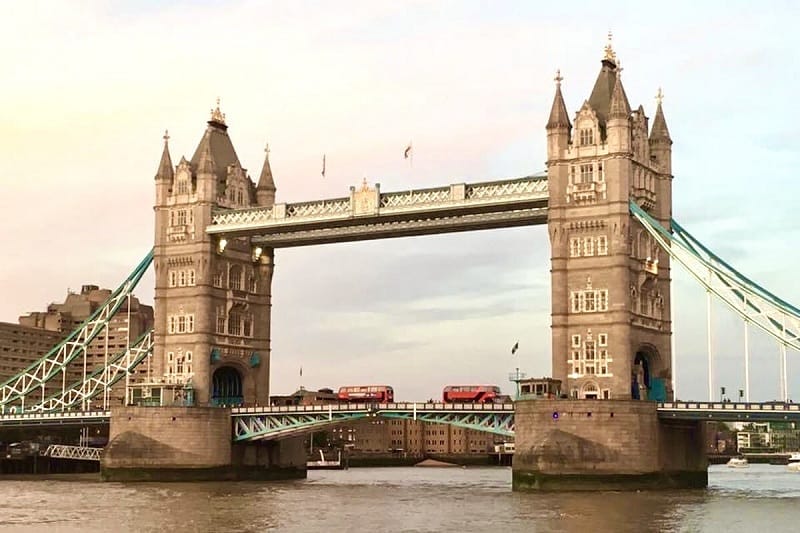
Photo credit: Vagabond Disposition
What is the longitude of London?
The longitude of London England is 0°7′ W, which is 0.12 degrees West of the Prime Meridian. This means London is located further west than Paris, making it closer to North America than its European neighbor.
What parallel is London England?
London England is located in the Northern Hemisphere, so it lies on the 51st parallel north. This means that it is at 51 degrees north of the equator.
London’s main airport, Heathrow Airport, lies on the same parallel as its city center – in this case, the 51st parallel.
Does latitude impact hours of daylight in London?
Absolutely, the latitude of a city significantly influences its daylight hours.
As you journey away from the equator towards the poles, the summer days extend, and the winter nights become longer.
This impact is quite apparent in London, located on the 51st parallel north in the Northern Hemisphere.
During the summer months, London enjoys longer daylight hours, perfect for extended sightseeing, and then in winter, the days are much shorter.
You’ll want to keep this in mind when making your travel plans. You can certainly fit in a lot more sightseeing in the summer in London!

Photo credit: Dymabroad
Does longitude impact hours of daylight?
No, longitude does not impact the hours of daylight in a given location. The hours of daylight depends only on its latitude.
Longitude is only used to pinpoint the coordinates of a city. It does not change the amount of daylight hours experienced in any given season.
How many hours of daylight are there in London in the summer?
In the summer, there are usually around 16-17 hours of daylight in London (based on ‘official’ sunrise and sunset times).
This varies slightly from day to day, but overall, you can expect plenty of daylight during the summer months in London.
The longest day is on the summer solstice, which is usually on the 20th or 21st of June.
Even after the sun has set you will still see some light in the sky, so true darkness is quite a bit later. In northern cities, a summer day in Dublin or London feels like it goes on forever!
This makes it the perfect city for long summer days filled with sightseeing and exploring!
How many hours of daylight are there in London in the winter?
In the winter, there are usually around 8-9 hours of daylight in London. This varies from day to day, but overall you should expect much shorter hours of daylight during the winter months.
(That’s only half of the hours of daylight in the summer! Those long winter evenings are great for enjoying a pint in a friendly pub or snuggling up with your special someone in front of a cozy fire.)
The shortest day is the winter solstice, which is typically on December 21 or 22.
So, if you’re visiting London in the winter, be sure to plan your sightseeing carefully to make the most of those precious daylight hours!

Photo credit: She Roams the Globe
Does latitude affect climate?
Yes, latitude does affect climate. As you move away from the equator and closer to the poles, temperatures tend to be cooler in general.
This is why places located on higher latitudes like London and Dublin tend to have more temperate climates and experience four distinct seasons.
Conversely, places with lower latitudes (such as the latitude of Rome, the capital of Italy) will tend to experience more tropical climates. These locations will experience much less temperature variation throughout the year.
While latitude is a large factor in a city’s climate, it is not the only one. Other variables affecting climate include elevation and proximity to large bodies of water.
What is the climate in London?
The climate in London is classified as a temperate oceanic climate.
London summers are generally warm, and its winters are cold. London experiences rainfall throughout the year, so be sure to carry along an umbrella on your trip to London!
What is the daily temperature range in London?
The daily temperature range in London varies greatly depending on the season.
In the summer, temperatures typically range from 17-25°C (63-77°F). London doesn’t often get heat waves, but it can still be quite warm during summer months. Make sure your hotel has air conditioning and bring a bottle of water to stay hydrated.
In the winter, temperatures range from 4-12°C (39-54°F). London can have days where the temperature drops below 0°C (32°F) in its coldest months of January and February.
It’s important to bring appropriate clothing and layers for both summer and winter when visiting London. Temperatures can fluctuate more than the yearly average, so it’s a good idea to be prepared.
You won’t want to miss out on any sightseeing due to being unprepared for the weather! So plan ahead and enjoy exploring London in comfort and style.
Does it snow in London?
Yes, it does snow in London. On average, London gets around 15-25 days of snow each winter.
Snow usually falls in small amounts and won’t last very long before melting away since London doesn’t get bitterly cold during the winter.
What city is on the same latitude as London?
The Canadian city of Calgary has a latitude very close to that of London, with a latitude of 51.0447° N.
In Europe, the latitude of Bruges, Belgium has a latitude of 51.2092° N, and Cologne Germany is 50.9375° N, both of which are close to the London latitude of 51.5072° N.

What US city is on the same latitude as London?
All of the continental United States is further south than London. The state of Alaska is of course much further north than London! Even Ketchikan, which is one of the more southern towns in Alaska, still has a latitude of 55.3422° N.
Are Seattle and London on the same latitude?
No, Seattle and London are not on the same latitude. The latitude of Seattle Washington is 47.6061° N, which is significantly different than London’s latitude of 51.5072° N.
Even though a summer day in Seattle is long, it doesn’t have as many hours of daylight as a day in London!
London Latitude and Longitude Fun Facts
The latitude of Westminster Abbey is 51.4994° N and the longitude is 0.1273° W. Westminster Abbey is one of the most important churches in England as it is where events such as royal weddings and coronations take place.

Photo credit: Andoreia Travels the World
The coordinates of Buckingham Palace are 51.5014° N, 0.1419° W, and it is located in the borough of Westminster. The major attractions in London are all located fairly close to each other, making it easy to see many sights in a short period of time.
Heathrow Airport, the largest in the UK, is located at coordinates of 51.4680° N and 0.4551° W. Located west of London in the borough of Hillingdon, Heathrow is the busiest airport in Europe!
The famous London landmark of Big Ben is located at the coordinates of51.5007° N, 0.1246° W.

Latitude and Longitude FAQ
Latitude, partnered with longitude, is a geographical coordinate that pinpoints any specific location on Earth’s surface. Latitude measures the positional degrees north or south from the equator, starting at 0° at the equator, and stretching all the way to 90° at the North or South Poles.
Think of the equator as an invisible ring that goes around our planet, slicing it into two halves: the top one being the Northern Hemisphere, and the lower one being the Southern Hemisphere.
It’s positioned at 0 degrees latitude, right smack in the middle between the North and South Poles.
Longitude, along with its counterpart latitude, forms the two coordinates responsible for identifying any location on Earth’s surface. Longitude is measured as degrees east or west from the Prime Meridian, spanning from 0° at the Prime Meridian up to 180° either east or west.
London is located at the coordinates of 51.5074° N (latitude) and 0.1278° W (longitude). This means that London is located 7 minutes and 40 seconds west of the Prime Meridian, which lies at 0 degrees longitude.
The Prime Meridian is an imaginary line that bisects Greenwich, England. Established by the British Royal Observatory in 1851, it serves as a reference point for longitudinal measurements.
With a designation at 0 degrees longitude, the Prime Meridian splits the Earth into the Eastern and Western Hemispheres. The longitude of any place on Earth is determined by its angular distance east or west from this line.
(This is also the location used in the determination of Greenwich Mean Time.)
Latitude and longitude are essential for accurately locating any place on Earth’s surface.
Latitude, expressed in degrees, tells us how far a place is to the north or south of the equator, ranging from 0° at the Equator to 90°N/S at the poles. On the other hand, longitude denotes the east or west distance from the Prime Meridian, stretching from 0° at the Prime Meridian to 180° east/west.
By combining these latitudinal and longitudinal coordinates, we can accurately specify any location in the world, such as the fascinating city of London!
A parallel is a conceptual line encircling the Earth, stretching around the globe. These conceptual lines run parallel to the equator, as if you were slicing up the globe from bottom to top like a tomato.
Its measurement in degrees starts at 0° at the equator and extends up to 90°, either north (N) or south (S), at the poles.
No, a parallel is not the same thing as latitude.
A parallel is an abstract line circling the globe, and latitude, on the other hand, pairs with longitude as two coordinates that pinpoint a location on Earth’s surface.
Imagine latitude like horizontal rungs on a ladder extending from 0° at the Equator to 90° at the poles in both the North and South. Longitude works similarly, starting at 0° at the Prime Meridian and going up to 180° both east and west. Combine these coordinates to pinpoint any spot on Earth!
Final Thoughts:
There you have it! Now you know everything about the latitude and longitude of London.
And you’ll be well informed for what to expect when visiting London throughout the year, from seasonal temperatures to hours of daylight (all of which are impacted by the latitude of London!)
So, who’s ready to start planning their next trip to London? I know I am!
With this helpful information, you’ll be able to make the most of your time in London. Happy Travels!
You may also enjoy these posts about England’s neighbor to the West, Ireland!
Lisa Garrett
Lisa Garrett is a professional travel advisor and the founder of Waves and Cobblestones and Travel to Lyon. She has sailed 50 cruises across 11 cruise lines and has extensive firsthand experience traveling throughout Europe, including France, Italy, Portugal, Belgium, and more.
A passionate traveler and former engineer, Lisa brings her experience in research, planning, and problem-solving to helping clients plan memorable European vacations and cruises.
Learn more about Lisa!
