
Planning a trip to France? You’re going to need some France currency!
I’ve traveled to France nearly a dozen times, so I know what you need for a smooth and stress-free vacation in France.
I’ve found that most shops and restaurants in large French cities – like Paris, Lyon, Nice and Marseille – accept credit cards as payment.
But smaller businesses may not, especially if you take day trips to smaller French towns.
It is always a good idea to have some money in France for small purchases and places that don’t accept credit cards. For example, for buying a baguette at a small mom-and-pop bakery, or for tipping your tour guide.
Are you wondering to yourself, ‘What is France’s currency?’ Don’t worry, I’ve got everything that you need to know before your trip!
Disclaimer: This page may contain affiliate links. I earn a small commission if you make a purchase through these links (at no additional cost to you). See our Privacy Policy and our Disclaimer for more information.
What is the currency of France?
The official currency of France is the euro. The symbol of the euro is €.
And since France currency is the euro, that means that Paris currency is the euro.
France was one of the first European countries to start using the euro. Euro bills and coins began circulating as legal tender in France on January 1, 2002.
Eleven other countries started using the euro as legal tender on this same date.

What is the euro?
The euro is a monetary unit and the common currency of many of the member nations of the European Union (EU). The countries that use the euro are referred to as the ‘eurozone’ or the ‘euro area’.
The euro (EUR) is the second most traded currency in the world, after the United States dollar (USD).
Having a common currency between these European countries has a lot of benefits for the countries. For example, it makes trade easier by not having to contend with fluctuations in exchange rates between countries.
The euro is also a HUGE improvement for travelers to Europe!
If you were visiting multiple countries in Europe before the introduction of the euro, you’d have to carry several currencies or exchange currency multiple times during your trip. This was certainly a hassle.
Let’s use an example of a trip itinerary starting in Naples, continuing on to Paris, and ending in Barcelona.
Before the introduction of the euro, you would have needed three different types of money: Italian lira, French francs, and Spanish pesetas.
But now, all you need to do is pick up some euros and you’ll be set for your entire trip. With the euro, France’s currency is the same as the currency in Italy. Easy peasy!
Across the sea to the north, euros are used within Ireland, but not in the Nothern Ireland. (Northern Ireland is part of the UK.) Be sure to bring your euros to Dublin, since Dublin is not in Northern Ireland!
What do euros look like?
I think euros are some of the prettiest currencies. Each bill features a different design of architectural elements. One side depicts bridges and a map of Europe, and the other depicts arches, windows, and columns.
It is easy to tell the different denominations of euro banknotes apart. The different euro bills come in different colors and sizes. The largest denomination is also the physically largest bill, with bill sizes decreasing with denomination.
I found it really handy to be able to organize my wallet by size to quickly find a small bill (as compared to US dollars, where all bills are the same size and color). This is really helpful for people with vision impairments.
You’ll note plenty of security features, like watermarks and holograms, on the bills to prevent counterfeiting.

Photo courtesy of my good friend and fellow avid traveler, Leticia Hong
Euro denominations: euro banknotes
Euro bills come in seven denominations: €5, €10, €20, €50, €100, €200, and €500.
For travel, it’s good to carry a variety of denominations. But the larger bills are going to be a lot harder to spend, so stick with €50 and below.
- 500 EUR: This is the largest euro bank note, at 160mm x 82mm. This banknote is purple (my favorite) and features modern architecture. Note: This denomination is being phased out. You might still find older notes, but as of April 2019, €500 are no longer being issued.
- 200 EUR: Physical size: 153mm x 82mm. The yellow €200 bill features Art Nouveau architecture.
- 100 EUR: Physical size: 147mm x 82mm. The green €100 bill depicts Baroque and Rococo architecture.
- 50 EUR: Physical size: 140mm x 70mm. The orange €50 bill portrays Renaissance architecture.
- 20 EUR: Physical size: 133mm x 72mm. The blue €20 note features Gothic architecture. I love those arched stained-glass windows!
- 10 EUR: Physical size: 127mm x 67mm. The red €10 note depicts Romanesque architecture.
- 5 EUR: This is the smallest bank note, at 120mm x 62mm. The gray €5 note portrays Classical architecture.
Euro denominations: euro coins
In addition to the euro paper banknotes, there are also several denominations of euro coins. The smallest denominations are ‘cents’, where 1 cent = 1/100 of €1 (just like in US currency, where cents are 1/100 of $1).
Euro coins come in 8 denominations: 1 cent, 2 cent, 5 cent, 10 cent, 20 cent, 50 cent, €1 and €2.
Euro coins come in a variety of sizes, metals, and edge patterns. Some edges are completely smooth, some are evenly ridged, some are notched, and some alternate smooth and ridged sections.
This differentiation again helps the visually impaired to easily identify the various coins.
While the euro bills are the same across all counties, each country is able to choose its own design for the back of its coinage.
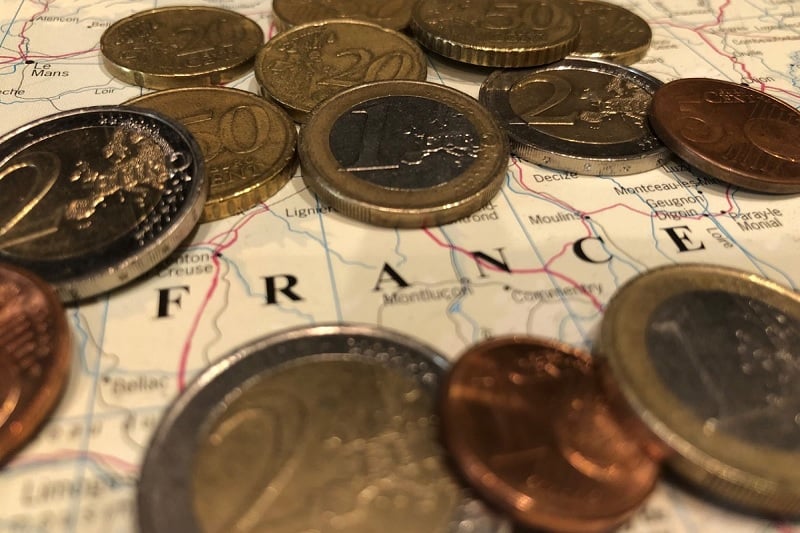
The €1 and €2 coins
The €1 and €2 coins are the easiest to pick out of a pile of change. They’re large and made of two different metals.
- €2: The €2 is the largest of the euro coins. The inside of the coin is a golden toned metal, with the outer ring a silvery tone. The edge of the coin is a set of very fine ridges, and if you look closely, you’ll see small patterns and letters spaced along the edge. My remaining €2 coins appear to be from France and the patterning is tiny numbers and stars.
- €1: The €1 is another two-toned coin, with the colors flipped from the €2 coin. On the €1 coin, the inside is the silver-toned metal, and the outer ring is the golden colored metal. The edge of the €1 alternates smooth sections and sections of very fine ridges.
The Nordic Gold coins
- 50c: The 50c euro coin is the largest of the fractional euro coins. The 50c coin is golden in color, a special composition called ‘Nordic gold’. Nordic gold is a copper alloy which is commonly used in currency. The edge of the 50c coin is patterned with thick ridges.
- 20c: The 20c coin is smaller than the 50c coin, but is also made of the golden ‘Nordic gold’ alloy. The edge of the 20c coin is smooth but marked with 7 regularly spaced indentations, or notches.
- 10c: The 10c euro coin is again smaller than the 20c coin, and is the third coin made of the ‘Nordic gold’ alloy. The edge of the 10c coin is patterned with thick ridges.
The smallest euro coins
- 5c: The 5c euro coin is slightly larger than the 10c coin, but now we’ve moved to a different metal. The 5c coin is copper in color with a smooth edge (like the US penny).
- 2c: The 2c euro coin is smaller than the 5c coin, and is also copper in color. The edge of the 2c coin is smooth but with a groove.
- 1c: The smallest denomination of the euro, the 1c coin, is physically quite tiny. The 1c coin is the baby version of its 5c big brother – it’s copper in color with a smooth edge.

Euro coins: tips
Pro Tip #1: Here’s another good reason to carry cash that no-one talks about: pay toilets. If you need to use the facilities when you’re waiting at the train station, you’ll need to make sure you have some small change on hand.
Typically, the fee for the restroom will be 50 cents or €1, but it can vary. Always keep an assortment of change in your pocket!
Prio Tip #2: I mentioned that the 5c euro coin looks a lot like a US penny. This makes it really difficult to find the right change if you have euros and US coins jumbled together in your coin purse.
I highly recommend bringing a Ziploc-type plastic bag along with you on your trip. Before you land in Paris (or whatever your European destination city is), put all your US change into the baggie.
And once you’re ready to come home, put the US coins back into your wallet, and put your euro coins into the bag. Be sure to keep the bag in a safe place – that you will remember! – and bring the French money back with you on your next trip to Europe.
Which countries use the euro?
The euro is the common currency of the European Union. However, not all of the countries in the European Union have met the economic stability criteria to be able to use the euro as legal tender.
The countries that do use the euro are considered to be part of the ‘eurozone’ or ‘euro area’. The countries that are not part of the eurozone still use their own national currencies. So, if you are visiting one of those countries, you’ll still need to exchange your money into the local currency.
Here is a list of the current countries in Europe that are part of the eurozone and use the euro as legal tender:
- Austria
- Belgium
- Croatia (scheduled to join the eurozone and the Schengen Area Jan1 2023 – congrats, Croatia!)
- Cyprus
- Estonia
- Finland
- France
- Germany
- Greece
- Ireland
- Italy
- Latvia
- Lithuania
- Luxembourg
- Malta
- the Netherlands
- Portugal
- Slovakia
- Slovenia
- Spain
Here are the countries that are part of the European Union, but have not met the economic stability conditions required to join the eurozone. (So, you’ll need local currency in these countries.)
- Bulgaria
- Czechia
- Hungary
- Poland
- Romania
- Sweden
And, we have one country that is part of the European Union, but that has opted out of using the euro as its legal tender. (Note that European Union member states can opt-out of various EU policies.)
- Denmark
Here is a handy map to help you visualize which countries are in the European Union, which are in the eurozone, and which are part of the Schengen area. This has been created based on Croatia’s plan to become a member of the eurozone and Schengen area on January 1, 2023.

Currency exchange rates
When you’re traveling abroad, it’s important to know the currency exchange rates for your home currency to the currency of the country you’re visiting.
It’s easy to see a price and associate it to your home currency without doing the proper math. This can be a costly mistake!
On our first visit to Paris after the money in France became the euro, the US dollar to euro exchange rate was not favorable to the US. It was around €1 = $1.3. So, if your hotel cost €100/night, it was really a price of $130/night.
The exchange rates have been getting much more favorable for the US in recent years. When we visited Paris in November, the exchange rate was nearly at parity – around €1 = $1.04. When the exchange rates are close like this, it’s a lot easier to keep on your budget.
Be sure to check the current exchange rates for your home currency vs the euro prior to your travels. This currency converter will give you the current exchange rate between any two currencies.
What was the previous currency of France?
Before the introduction of the euro, the previous currency of France was the French franc. In 1795 (after the French Revolution), the republican government introduced the French franc (FF) as a monetary unit.
The French franc became the official currency of France in the year 1799. Smaller monetary units, franc coins, were décimes (10 décimes = 1 franc) and centimes ( 100 centimes = 1 franc).
(Prior to the French franc, the French livre was the national currency of France. There is a long history of other French currencies, including the livre tournois and French coins such as the gold louis and the silver écu.)
After the adoption of the euro as the official French currency in January 2002, there was a brief period where both the euro and the franc were accepted as legal tender. The franc was no longer accepted as legal tender in France after February 17th, 2002.
The fixed exchange rate of the French franc to euro : €1 = 6.55957 FRF.
If you still have old francs from a previous trip to France, I’m sorry to say that they are just souvenirs now. The Banque of France stopped exchanging francs for euros in 2012.
How to get money for your trip to France
There are several ways to get euros for your trip to France.
If you want to be prepared and have some euros before you leave home, you can order foreign currency from your local bank.
Note that this option will be more expensive than getting cash from an ATM once you get to France. But for me, it was worth it for my peace of mind.
My bank used a slightly different euro-to-dollar exchange rate for the currency purchase (to their advantage) and also charged a shipping fee. But I received the currency within 48 hours of my order.
The least expensive way to get cash in France is to visit an ATM affiliated with a bank once you arrive in France. (If you choose an ATM that is not affiliated with a bank, you will likely be charged cash withdrawal fees by the ATM.)
Also, be aware of your bank’s policies for withdrawing cash in a foreign country, as your bank might charge fees in addition to the fees levied by the ATM. (Be sure to notify your bank that you’ll be traveling, to reduce the chances that your transactions will get flagged or denied.)
When withdrawing cash, always choose the option to pay in the local currency, to avoid currency exchange rate markups.
A third option is to use money exchange offices. Here the exchange rate will be much worse than the official rate, and the office may also charge a commission or fee on the transaction. If you must use a money exchange bureau, try to avoid the ones at the airport.
France Currency FAQ
Yes, France uses euros. The euro has been the official currency in France since January 1, 2002.
No, France does not still use francs. The euro is now the legal French currency.
No, U.S. Dollars are not accepted as payment in France. You will need to pay in euros.
France’s main currency is the euro (and the euro is the only currency that is accepted in France).
No, U.S. Dollars are not accepted in Paris. The currency used in Paris is the euro.
Yes, people use cash in Paris. Although credit cards are widely accepted in Paris, there are many small businesses that may only accept cash. Be sure to have bring some currency in Paris!
Before the euro, the currency in France was the franc. The euro became France’s currency in January 2002.
Yes, it is a good idea to take euros to France. Although you will be able to make many purchases with your credit card, you should always have some cash on hand for small purchases.
Sorry! The franc is no longer accepted as payment in Paris. The euro is now the money used in Paris.
Paris currency is the euro. Paris is the capital city of France, and since the official currency of France is the euro, that means the official currency of Paris is the euro.
Final Thoughts:
Now you know all the essential information about the currency used in France, and can now answer the question, “What currency does France use?“
So go get some euros and have a fantastic trip! Bon Voyage!
You might also enjoy these posts about my favorite places in France:
- Best Things to do in Paris France
- Best Paris Night Tours
- Le Jardin du Luxembourg Paris
- Best Things to Do in Lyon France
- How to Take a Loire Valley Hot Air Balloon Ride
- Best Things to Do in Avignon and Arles
- Top Things to Do in Nice and the French Riviera
- Best Paris Day Trips by Train
Planning to travel to France? Pin this post for later so you remember what currency is used in France!


Lisa Garrett
Lisa Garrett is a professional travel advisor and the founder of Waves and Cobblestones and Travel to Lyon. She has sailed 50 cruises across 11 cruise lines and has extensive firsthand experience traveling throughout Europe, including France, Italy, Portugal, Belgium, and more.
A passionate traveler and former engineer, Lisa brings her experience in research, planning, and problem-solving to helping clients plan memorable European vacations and cruises.
Learn more about Lisa!
