
Planning to visit the Montreal Botanical Garden?
The gardens are one of the top attractions in Montreal. If the weather is nice, it’s the perfect way to spend a few hours and reconnect with nature.
I took a trip to Montreal last summer, and visiting this garden was one of the highlights of my trip.
The Montréal Botanical Garden has twenty different themed outdoor gardens (my favorites are the Chinese Garden and the Japanese Garden). And don’t miss the stunning flowers in the exhibition greenhouses!
Ready to discover the best things to see at the Montréal Botanical Garden? Lace up your shoes and let’s go!
Disclaimer: This page may contain affiliate links. I earn a small commission if you make a purchase through these links (at no additional cost to you). See our Privacy Policy and our Disclaimer for more information.
Quick Picks: Top Montréal Tours
- Full-Day Montréal City Tour + Local Specialties (Top rated!)
- Old Montréal Private Walking Tour (Personalized private tour)
- Montréal Walking Tasting Tour (My top pick for Montréal food tours!)
- Guided Scooter Sightseeing Tour of Montréal (A fun way to see the city!)
- Quebec and Montmorency Falls Day Trip (Top seller!)
Visiting the Montréal Botanical Garden

The Montréal Botanical Gardens are located a few miles north of most of Montréal’s most popular attractions (Vieux Montréal and the Parc du Mont-Royal).
But I think it’s totally worth venturing a little further afield to see these beautiful gardens. They’ve got more than 21,000 plant species across a whopping 75 hectares!
1. Chinese Garden

The Chinese Garden is the most popular garden. It certainly is the most elaborate and impressive!
Several beautiful Chinese structures, both large and small, ring the central lake. I’d call them pagodas, although is not probably their real classification. Their traditional architectural style is patterned after Ming dynasty structures.
The buildings were actually shipped in thousands of pieces from Shanghai and reassembled in the Montreal Botanical Garden by a team of fifty Chinese artisans. Even the gray rocks you see all around the Chinese Garden originated from China’s Tai Lake – all 500 tons of them!
On my visit, Dream Lake was filled with fantastical creatures such as dragons. (I don’t know if these decorations are present year-round, or whether they were there in preparation for the upcoming Gardens of Light festival in the fall).
Be sure to walk around the lake to explore all seven of the classical Chinese buildings and the other elements of the Chinese Garden.
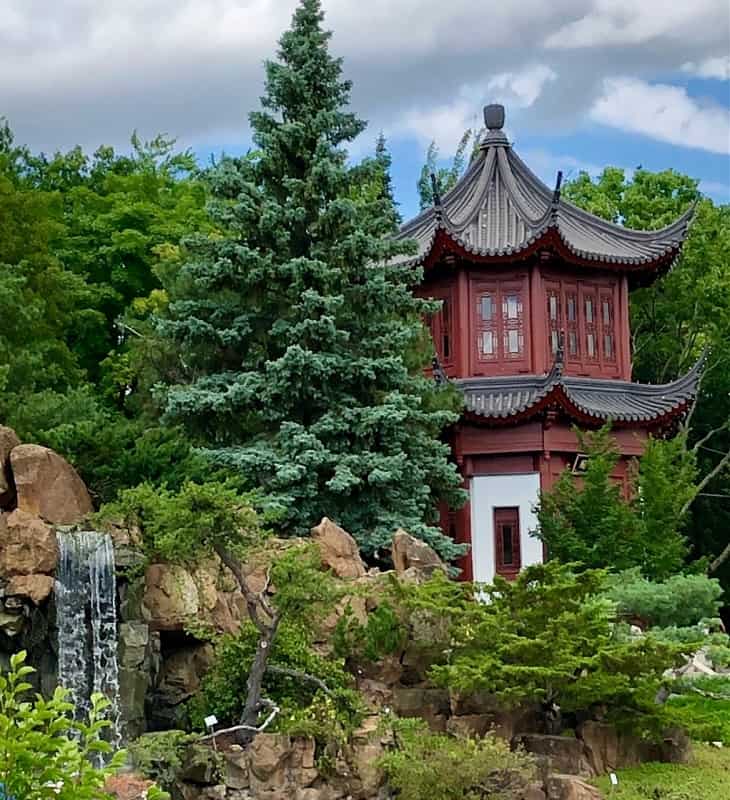
Friendship Hall is the largest structure, facing the Tower of Condensing Clouds and waterfall on the opposite shore.
The roof of Friendship Hall is decorated with traditional Chinese creatures including the phoenix and the dragon.
The Springtime Courtyard contains another collection of styled bonsai trees.
The best time to visit the Chinese Garden is in the months of May through October. Note the Gardens of Light festival is held in the months of September and October (see the FAQ section below for more information on the Gardens of Light).
2. Rose Garden
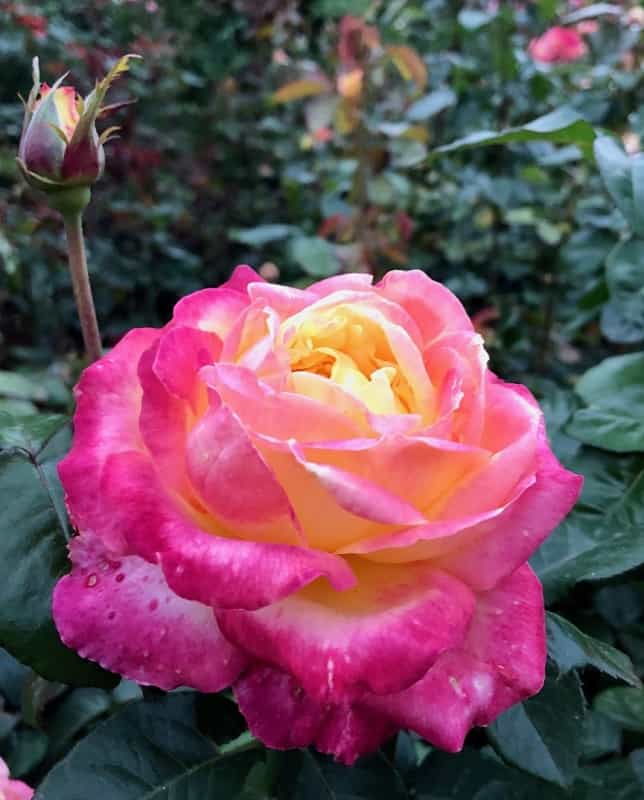
The first garden you’ll encounter is the Rose Garden or Roseraie.
The Rose Garden was created in 1976 to honor the Olympic Games which occurred in Montréal. Covering over six hectares, this is one of the largest rose gardens in North America.
This garden boasts nearly 10,000 rose bushes representing over 900 species of roses! The rose gardens contain two sections – the ornamental rose garden, and a garden featuring collections of rose species.
According to the garden’s web site, the best time to visit the Rose Garden is mid-June through the first frost.
I visited the botanic garden at the end of July, and the roses were not at their peak. I’d probably recommend visiting a bit earlier in the season if roses are your favorite.
3. Aquatic Garden

The Aquatic Garden is actually located in the middle of the Rose Garden.
Here you’ll find all manner of water plants, in raised above-ground basins so you can very easily take a closer look at the plants.
Some of the favorite aquatic plants are the water lilies and sacred lotuses. The starchy roots of the sacred lotus are commonly eaten in Asian countries.
The Victorias are attention-grabbing and have pride of place in the aquatic garden’s large central basin. These giant waterlilies, whose leaves lie flat on the surface of the water, can grow up to 3 meters across.
Victorias are native to South America but survive here Québec’s much colder climate thanks to the garden’s heated basins.
The best time to visit the Aquatic Garden is in the spring and summer, when the plants bloom. The flowers are generally at or above the surface of the water, to make pollination easier.
4. Japanese Garden

The Japanese Garden was one of my favorites within the Montréal Botanical Garden.
As you approach the Japanese Pavilion, you’ll find a little zen garden with stone and some small trees. There are some benches flanking this mini garden, if you want to give your feet a rest.
An enclosed courtyard behind the Japanese Pavilion contains a collection of bonsai trees. I was surprised to see many different species of trees formed into bonsai.

There is also a Tea Garden, which you can visit with a guided tour. Behind the Japanese Pavilion is the Peace Bell, a gift from Montréal’s twinned city of Hiroshima.
Definitely take some time to take a walk amongst the serene gardens behind the pavilion. If you’re visiting in the springtime, enjoy the cherry blossoms!
The best time to visit the Japanese Garden is in the months of April through October.
5. Insectarium

The Insectarium reopened in Spring of 2022 after a three-year transformation. The Insectarium is now 40% bigger and even better than before.
Some of the featured species in the Insectarium include the gorgeous blue morpho butterfly, the orchid mantis, and the Umtali rose chafer, a beetle with striking metallic colors.
In the Tête-à-Tête room, you can observe the behavior of various species up close. There are six enclosures, and the species on display are rotated throughout the year.
The Dome is a large circular display space with an airy 9-meter cathedral ceiling.
Here you’ll be able to view mounted specimens in dozens of showcases. The cases are arranged by color, and there are also specialty displays highlighting the diversity of characteristics of the insect world.
But the main draw of the Insectarium is the Great Vivarium. Enjoy watching the vibrant butterflies flying freely amongst the plants and water features in this airy glass enclosure.
6. Arboretum

The Arboretum makes up over half of the area of the Montreal Botanical Garden, covering over 40 hectares.
It contains about 6,000 specimens representing 800 species of plants and trees. So, if you’re planning to stroll through the Arboretum, definitely plan for a longer visit.
There are some spaces in the Arboretum that aren’t mowed as frequently. This allows wildflowers to bloom, which is good for pollinating species such as butterflies – and it also adds to the garden’s biodiversity.
Tip: This area is also a great spot for bird watching.
Since there are so many different types of trees and plants represented in the Arboretum, in spring and early summer you’ll always find something in bloom. The ornamental crabapples are one of the symbols of the city Montréal, and their spring blooms are spectacular.
May is the best time to visit the Arboretum for spring blossoms, for both the crabapples and the blossoms of the cherry trees.

Of course, the Arboretum is in its full splendor in autumn with the changing colors of the fall foliage. The best time to visit to view the fall colors is mid-September through mid-October. The maples are the highlight of the Arboretum in the autumn.
7. First Nations Garden
The First Nations Garden is the second of the cultural thematic gardens and honors the initial inhabitants of North America and their interaction with the land.
The hardwood forest includes oaks, sugar maples, and berries and includes an area where the ‘three sisters’ grow. Squash, beans, and corn were staples of the diets of the indigenous peoples.
The softwood forest includes birch trees and many types of plants with medicinal purposes. In this area you’ll also find habitat structures such as a wigwam and a teepee.
Ponds form much of the real estate of the First Nations Garden and were custom-built to provide the needed environment for specific plants. This garden also contains an interpretive pavilion with a ‘knowledge and know-how’ exhibit.
The best time to visit the First Nations Garden is from May through October.
8. Themed Gardens

There are several smaller themed gardens running along the southwestern edge of the Montreal Botanical Gardens. These bring to mind formal landscaped English or French gardens.
Some of the gardens you’ll find running along Pie IX Boulevard include:
- The Food Garden contains all manner of nutritional plans including grains, vegetables, legumes, spices, and even edible flowers. (Don’t worry, this food doesn’t go to waste. It is donated to a food charity.)
- The Medicinal Plants Garden showcases plants historically used for curing various ailments. Note that many of these plants are beneficial in small doses but can be detrimental or even lethal in larger quantities!
- The Monastery Garden represents an ordered place for quiet meditation, as one would traditionally find in a monastery.
- The Perennial Garden takes on both English and French garden styles. The perennial garden’s plants are chosen so that some plant is always in bloom. This particular garden contains nearly 1700 plant species!
9. Exhibition Greenhouses

And last, but certainly not least, we have the exhibition greenhouses.
These were one of the highlights of the Montreal Botanical Garden for me. I bet that a lot of people miss out on them since they’re indoors.
The ten exhibition greenhouses make up one long interconnected building. You can visit these first if you take a left (rather than a right) after purchasing your tickets.
Each of the greenhouses is set to the conditions needed to best nurture the plants. Some are very dry, some are humid, and some are continually being misted.
From the hospitality greenhouse, if you take a left you head to the drier zones. Head right to visit the humid greenhouses, such as the tropical rainforest, orchid, and fern greenhouses.
The exhibition greenhouses are open year-round and are a great way to get your flower fix during Montréal’s winters!
Montréal Botanical Garden Tips and FAQ
What is the closest metro station to the Montréal Botanical Garden?
The closest metro station to the Montreal Botanical Garden is the Pie IX metro station, on the green line. From the Pie IX station, you’ll walk uphill to get to the entrance to the garden. It’s located at 4101 Sherbrooke Street East.
Don’t worry, it will only take you a few minutes. Unless, like me, the amazing architecture of the Olympic Stadium proves distracting, and you need to take a detour for a closer look! (Montréal, Canada hosted the 1976 Summer Olympics.)
Here you can see the stadium with the Olympic rings and a medals podium:

Is there free parking at the Montréal Botanical Garden?
Unfortunately, Montreal Botanical Garden parking is not free, and it is not included with the cost of admission to the gardens.
Current pricing is $12.75 CAD to park for the day (about $10 USD at current exchange rates). This day parking pass is valid for all three Space for Life (or Espace pour la Vie) parking lots – the two at the botanical garden, and the one by the biodome/planetarium.
You can try parking on the street in the nearby residential areas if you don’t want to pay for on-site parking.

How much does the Montréal Botanical Garden cost?
Admission to the Montreal Botanical Garden costs $22 CAD for adult (around $17 USD at current exchange rates). Reduced rates are available for students, children, seniors, family passes.
(Note: during the summer months (May-October) you can take a guided tour of the gardens — at no additional charge beyond the admission ticket!)
Tip: Buy your tickets online to reserve your entry (the gardens do have capacity limits). This also allows you to skip the line once you get to the gardens. On the day of my visit, this would have saved me about 20 minutes in line.
Tip: Montréal residents with an Accès Montréal card can visit the grounds of the gardens for free. This does not include access to the insectarium or the exhibition greenhouses, although special rates are available to Accès Montréal cardholders.
Montreal Space for Life Passport
The Montreal Space for Life passport (Espace Pour La Vie Passeport) is a great deal if you live in Montréal or will visit the city more than once within a year. The Space for Life passport gives you access to five attractions for 12 months.
The attractions include: Biodôme, Biosphère, Insectarium, Jardin botanique and Planétarium Rio Tinto Alcan. Cost for the passport is $80 CAD for adult (about $61 USD at current exchange rates). There are discounts for adult plus child or family passes.
The passport also gives you discounts at the garden’s restaurants and gift shop.
Tip: Passport holders still need to reserve entry tickets online to visit on a given day, since the gardens do have a capacity limit.
When is the best time to visit the Montréal Botanical Garden?
The Montreal Botanical Garden is open year-round, but the best time to visit is in the warmer months (May through early September) to enjoy the peak of the flowers in bloom.
Different flowers have different peak seasons, so for example if you’re keen on roses, you’ll want to visit in June for the most impressive displays.
If you visit in September and October, you’ll be able to experience the Gardens of Light (see more on that below).
Plus, later in the season you can enjoy the colors of the fall foliage showcased in the arboretum – the maples are especially lovely.
In the winter, snow blankets the outdoor gardens. You can still enjoy a winter walk through the snow-covered gardens and arboretum. To see flowers, you’ll want to spend your time in the climate-controlled exhibition greenhouses.

How long should I spend at the Montréal Botanical Garden?
Unless you’re a major botanical enthusiast, 2-3 hours should be plenty for your visit to Montreal’s Botanic Garden. This will give you plenty of time to explore the main highlights of the garden.
If you want to stroll through the arboretum, plan for more time, as that is an extensive area.
If you’re visiting the garden on a day of a special event (like the Gardens of Light) you’ll definitely want to plan for a longer visit.
Special Events at the Montreal Botanical Garden
In addition to the year-round beauty of the gardens, there are many special Montreal Botanical Garden events. If you’re in Montréal during these times, you won’t want to miss them!
Summertime outdoor concerts
Spend a Sunday afternoon enjoying a free outdoor concert in the Montreal Botanical Garden. The concerts are free with the purchase of a ticket to the gardens.
The concert series is typically held in late June through late August on select Sundays – check the gardens’ web site for the schedule.
You’re allowed to bring chairs to the garden for the concerts. Be sure to bring a hat as the concerts are held in an open-air, sunny area.
Gardens of Light
The Gardens of Light (Jardins De Lumière) event occurs in September and October. As you might guess, this event happens at night, with the garden’s three cultural gardens illuminated.
The First Nations Garden’s experience focuses on the Sacred Tree, which symbolizes the Circle of Life. And in the Japanese Garden, you can follow the illuminated meditative path.
The highlight is the Chinese Garden, featuring hundreds of vibrantly colored silk lanterns decorating the whimsical sculptures in the lake. That’s why this popular event is commonly known as the Montreal Lantern Festival or Chinese Lantern Festival.
Tip: Be sure to purchase your ticket in advance, as this popular event sells out. You’ll need to pick a specific date and time for your Gardens of Light visit. Your ticket allows you to explore the garden during the day, so you can enjoy the beauty of the flowers and the fall colors as well as the evening illuminations.
Mosaïculture / MosaïCanada
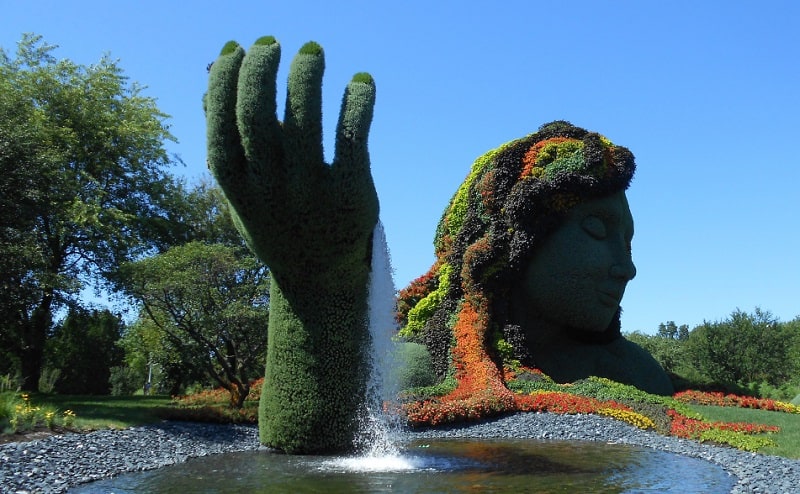
Mosaïculture (a combination of the words mosaic and horticulture) is an incredible event. Giant elaborate topiaries filled with plants and flowers make up amazing scenes.
Mosaïculture events are held annually in different cities, but Montréal has been the host city many times. Several times, the event was held in the area of the Old Port of Montréal. In 2013, the magnificent event was held in the Montreal Botanical Garden.
If Mosaïculture makes a return appearance in Montréal, you will definitely want to get tickets!
Final Thoughts..
The Montreal Botanical Garden is a great way to spend a sunny day when you’re in Montreal. (Even if you have a brown thumb, like me!)
These lush and colorful gardens are a far cry from the cacti in the Phoenix Desert Botanical Garden back home!
Check out these posts to help you plan your trip to Canada:
- Best Cities in Canada to Visit
- Best Canada Summer Trip (Montreal, Ottawa, and Toronto)
- Best Tours in Ottawa
- Montreal or Toronto
- Top Montreal Food Tours
- Best Ottawa Things to Do
- Best Things to Do in Victoria
Are you ready to book your trip to Montréal?
Looking for the top picks for your trip to Montréal? Here are some of the best tours, hotels, and more to help you plan the perfect vacation in Montréal!
Top Tours and Experiences in Montréal
- Full-Day Montréal City Tour + Local Specialties (Top rated!)
- Old Montréal Private Walking Tour (Personalized private tour)
- Montréal Walking Tasting Tour (My top pick for Montréal food tours!)
- Helicopter Tour over Montréal (A ‘splurge’ experience!)
- Guided Scooter Sightseeing Tour of Montréal (A fun way to see the city!)
- Quebec and Montmorency Falls Day Trip (Top seller!)
Top Places to Stay in Montréal
- Le Square Phillips Hôtel & Suites (I stayed here! Suites include full kitchens, perfect for a longer stay.)
- Hôtel Le Germain Montréal (Perfect for couples! In-room massages available)
- Hotel Nelligan (Amazing location in Vieux Montreal!)
Pin it for later! Don’t miss out on the beautiful Montreal Botanical Garden!

Lisa Garrett
Lisa Garrett is a professional travel advisor and the founder of Waves and Cobblestones and Travel to Lyon. She has sailed 50 cruises across 11 cruise lines and has extensive firsthand experience traveling throughout Europe, including France, Italy, Portugal, Belgium, and more.
A passionate traveler and former engineer, Lisa brings her experience in research, planning, and problem-solving to helping clients plan memorable European vacations and cruises.
Learn more about Lisa!
